

Adult Acne: Why It Happens After 25 and What Actually Clears It
Adult acne affects nearly half of women in their thirties. The causes are different from teenage acne, and so is the treatment.
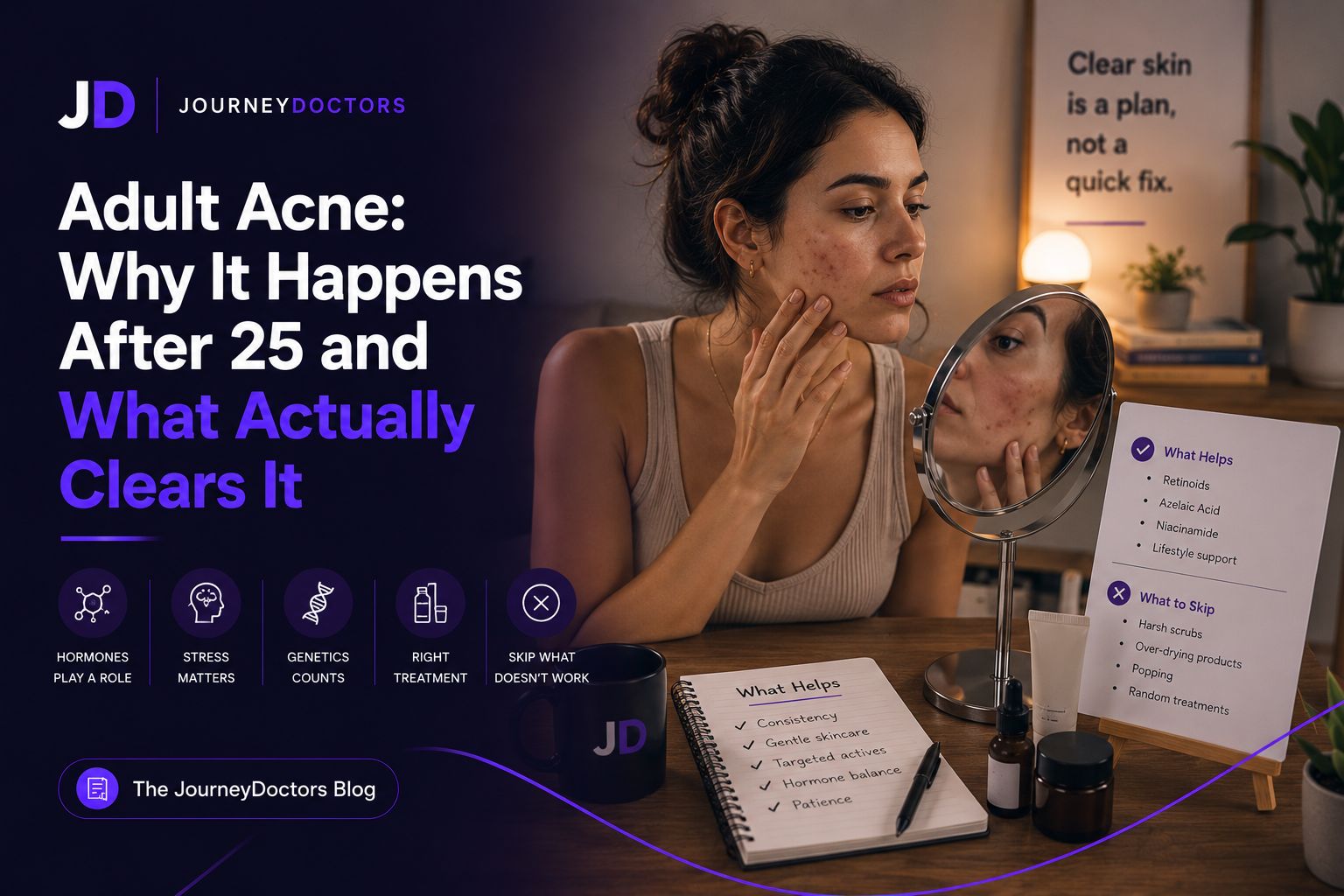
Adult acne is one of the most frustrating skin conditions I treat in my dermatology practice, partly because it surprises people. There is a persistent cultural belief that acne is a teenage problem that resolves by your mid-twenties. For a substantial portion of the population, particularly women, this is simply not true. Studies show that acne affects approximately 45 percent of women aged 21 to 30, around 26 percent of women aged 31 to 40, and about 12 percent of women in their forties. Male adult acne exists but is considerably less common after adolescence. Understanding why adult acne happens, and why the solutions that help teenagers often do not help adults, is the starting point for actually treating it effectively.
Why Adult Acne Is Different From Teenage Acne
Teenage acne is primarily driven by a surge in androgens during puberty, which increases sebum production across the entire face. The result is often widespread comedone formation and inflammatory lesions distributed broadly across the forehead, nose, and cheeks.
Adult acne tends to be lower on the face. The distribution typically concentrates along the jawline, chin, and lower cheeks, a pattern that points directly to hormonal fluctuation as the primary driver. Hormones, particularly androgens, stimulate the sebaceous glands in this lower facial zone more than elsewhere. When androgen levels fluctuate, whether from the menstrual cycle, stress, or conditions like polycystic ovary syndrome, this area flares.
Adult lesions also tend to be deeper and more painful than teenage whiteheads and blackheads. Nodular and cystic acne, the type that sits deep under the skin and does not come to a head easily, is more common in adults. This type is also more likely to leave post-inflammatory hyperpigmentation and scarring if not treated properly.
The Main Causes of Adult Acne
Hormonal Fluctuations
In women, the most common trigger for adult acne is the hormonal shift that occurs in the week before menstruation, when progesterone rises and estrogen falls. This creates a relative androgen surplus that stimulates sebum production. Women who notice acne flares in a predictable pattern before their period are experiencing what is often called cyclical or hormonal acne. This pattern responds very differently to treatment than non-hormonal acne, and topical retinoids and benzoyl peroxide alone will often prove insufficient.
Perimenopause is another hormonal transition that commonly triggers adult acne in women who had clear skin throughout their thirties. As estrogen levels decline and become erratic, the relative influence of androgens increases. I see this presentation frequently in women in their mid-forties who are surprised that they are breaking out for the first time since adolescence.
Polycystic ovary syndrome (PCOS) is a hormonal condition affecting five to ten percent of women of reproductive age. Acne is one of its cardinal features, alongside irregular periods, excess facial or body hair, and in some cases difficulty with weight management. Women with PCOS have elevated androgen levels and often find that their acne is more resistant to standard topical treatment. If you have persistent adult acne alongside any of the above symptoms, evaluation for PCOS is warranted.
Stress and Cortisol
Stress does not directly cause acne, but it significantly worsens existing acne through two mechanisms. First, cortisol, the primary stress hormone, stimulates the adrenal glands to produce androgens, which increases sebum production. Second, stress impairs the skin's barrier function and worsens inflammation, allowing acne lesions to develop more easily and heal more slowly.
Many patients report that their acne is unpredictable despite consistent skincare. Often, the variable is stress. When work intensifies, relationships are strained, or sleep suffers, acne follows. This is not a psychological phenomenon. It is a straightforward hormonal and inflammatory cascade.
Skincare Products and Makeup
Comedogenic products, those that block pores, are a common and often overlooked cause of adult acne. Heavy moisturizers, oil-based foundations, and certain sunscreens can occlude follicles and trigger breakouts in people who are already prone to acne. The frustrating thing is that many products labeled "non-comedogenic" have not been rigorously tested. In my practice, I often find that switching skincare products, particularly removing silicone-based primers and heavy occlusive moisturizers, makes a meaningful difference.
Over-washing and over-exfoliating are also counterproductive. Disrupting the skin barrier triggers compensatory sebum production and increases sensitivity to ingredients that would otherwise be well tolerated. Stripping the skin does not treat acne. It often makes it worse.
Diet
The relationship between diet and acne is more evidence-based than dermatologists historically acknowledged. High glycemic index foods, those that cause rapid blood sugar spikes, increase insulin and insulin-like growth factor 1 (IGF-1), both of which stimulate sebum production. Dairy, particularly skim milk, has also been associated with acne in multiple observational studies, though the mechanism is not fully established. Eliminating dairy and reducing refined carbohydrates and sugar is a reasonable dietary intervention to trial in patients with persistent adult acne.
Chocolate specifically has mixed evidence. The sugar and dairy content of most commercial chocolate is a more likely culprit than cocoa itself.
Medications
Several common medications can trigger or worsen acne. These include lithium, used for bipolar disorder; corticosteroids; certain progestin-only contraceptives; androgenic steroids; and some anticonvulsants. If your acne began or worsened after starting a new medication, this connection is worth discussing with your prescribing physician.
Treatments That Actually Work
JourneyDoctors
Not sure if this applies to you?
Describe your symptoms to Dr. Maya — our AI GP — and get a real clinical response in under a minute. Free to start.
Talk to Dr. MayaTopical Retinoids
Retinoids are derived from vitamin A and are the most evidence-supported topical treatment for both comedonal and inflammatory acne. They work by accelerating skin cell turnover, preventing the formation of the follicular plugs that become comedones and create the anaerobic environment in which acne bacteria thrive. Prescription tretinoin is more potent than over-the-counter retinol. Side effects include initial irritation, dryness, and a purging phase in which existing microcomedones are pushed to the surface before improvement occurs. This purging period, typically lasting four to six weeks, is often mistaken for the treatment making acne worse.
Benzoyl Peroxide
Benzoyl peroxide kills Cutibacterium acnes, the bacteria that drive inflammatory acne, and does so through an oxidative mechanism that does not produce antibiotic resistance. It is available over the counter in concentrations from 2.5 to 10 percent. Higher concentrations are not more effective for most people and cause more dryness. Benzoyl peroxide bleaches fabric and can cause allergic contact dermatitis in some individuals.
Topical Antibiotics
Clindamycin and erythromycin, usually in gel form, reduce bacterial load and inflammation. They should not be used as monotherapy due to the risk of antibiotic resistance. Combining a topical antibiotic with benzoyl peroxide significantly reduces resistance risk and improves efficacy. Most guidelines recommend time-limiting topical antibiotic use to three to six months.
Hormonal Therapy for Women
For women with clear hormonal acne, particularly the jawline and chin pattern with cyclical flares, hormonal interventions often produce better results than topical treatments alone. Combined oral contraceptives (those containing estrogen and certain progestins) lower androgen levels and are FDA-approved for acne treatment. Spironolactone, an aldosterone antagonist, blocks androgen receptors in the skin and is highly effective for adult female hormonal acne. It is not appropriate in pregnancy and requires monitoring of potassium levels. I consider spironolactone when acne is predominantly hormonal in pattern and has not responded adequately to topicals.
Oral Antibiotics
Doxycycline and minocycline are the most commonly prescribed oral antibiotics for moderate to severe inflammatory acne. They reduce bacterial load and have independent anti-inflammatory effects. They should be used for a defined course, typically three to six months, in combination with topical treatment, not indefinitely as monotherapy.
Isotretinoin (Accutane)
Isotretinoin is the most effective acne treatment that exists. It achieves complete and often permanent clearance in the majority of patients with severe nodular or cystic acne after a single course. It works by dramatically reducing sebaceous gland size and sebum production. It is a pregnancy category X drug, meaning it causes severe birth defects, and is dispensed through a mandatory monitoring program in the United States (iPLEDGE). Side effects include dryness throughout the skin and mucous membranes, increased sun sensitivity, and in some patients mood changes. The link between isotretinoin and depression has been extensively studied; the evidence is mixed, and the relationship is not established as causal. Untreated severe acne itself causes depression. For patients with severe or scarring acne that has not responded to other treatments, the risk-benefit calculation for isotretinoin is usually strongly in its favor.
What Does Not Work
Toothpaste on spots: it dries the area but the components are not formulated for skin and can cause irritation and post-inflammatory marks. Tea tree oil: has mild antibacterial properties but insufficient evidence to recommend as a primary treatment. Facial steaming to "open pores": pores do not open and close. Steaming can temporarily loosen debris but does nothing to address the structural causes of acne. Scrubbing and physical exfoliation: mechanically disrupts the skin barrier, worsens inflammation, and can spread bacteria.
Post-Inflammatory Hyperpigmentation and Scarring
One of the most important reasons to treat adult acne aggressively and early is the risk of permanent scarring. Picking at lesions dramatically increases this risk. Post-inflammatory hyperpigmentation, the dark marks that remain after a pimple resolves, is not scarring in the structural sense but can take months to fade, particularly in darker skin tones. Topical niacinamide, azelaic acid, and retinoids all help speed this resolution. Sunscreen is non-negotiable: UV exposure significantly darkens post-inflammatory marks and slows their fading.
When to See a Doctor
If your acne is not responding to consistent over-the-counter treatment after two to three months, causes pain, is leaving marks, or you suspect a hormonal cause, seeing a dermatologist is the right next step. The difference between guessing at the counter and targeted prescription treatment is significant, both in speed of improvement and in preventing scarring. JourneyDoctors dermatologists can evaluate your skin, discuss your pattern and history, and prescribe a treatment plan from $19.
Disclaimer: This article is for educational purposes only and does not constitute medical advice. Always consult a qualified healthcare professional for diagnosis and treatment of any medical condition.
Get proper care
Ready to speak with a specialist?
If anything in this article sounds familiar, the right next step is a proper evaluation. JourneyDoctors connects you with a specialist in minutes. Consultations from $19.
See a specialist nowFrequently Asked Questions
Is adult acne a sign of something wrong internally?
In most cases, adult acne reflects hormonal variation within a normal range rather than an underlying disease. However, acne combined with irregular periods, excess hair growth on the face or body, or unexplained weight changes warrants evaluation for PCOS or other hormonal conditions. Acne that begins suddenly in middle age with no prior history is also worth investigating.
How long does it take to see results from acne treatment?
Most topical treatments take six to eight weeks of consistent use before meaningful improvement is visible. Retinoids often cause an initial purging phase of four to six weeks before improvement begins. Oral antibiotics typically show results within four to six weeks. Setting expectations correctly prevents people from abandoning treatments that are actually working.
Does diet cause acne?
Diet influences acne but does not cause it in people without the underlying predisposition. High glycemic index foods and dairy, particularly skim milk, have the strongest association with acne in the evidence. Eliminating these is worth trialing for six to eight weeks if your acne is persistent and other interventions have been optimized.
Can I use multiple acne treatments at the same time?
Yes, and combination therapy is often more effective than single-agent treatment. The standard evidence-based combinations are retinoid plus benzoyl peroxide, or topical antibiotic plus benzoyl peroxide. Using too many active ingredients simultaneously can cause irritation that worsens acne. Introducing one new product at a time and allowing skin to adjust is the safer approach.
Does stress cause acne?
Stress worsens acne in people who are predisposed to it through cortisol-driven androgen production and increased inflammation. It does not create acne where none would otherwise exist. Managing stress has real but modest effects on acne; it works best as part of a comprehensive approach rather than as a primary treatment strategy.
Written by
Dr. Priya Sharma
Dermatology