

Atrial Fibrillation: What AFib Actually Feels Like and When It Becomes Dangerous
Atrial fibrillation causes a chaotic, irregular heartbeat that can feel like fluttering, racing, or nothing at all. The real danger is not the rhythm itself but the stroke risk it creates.
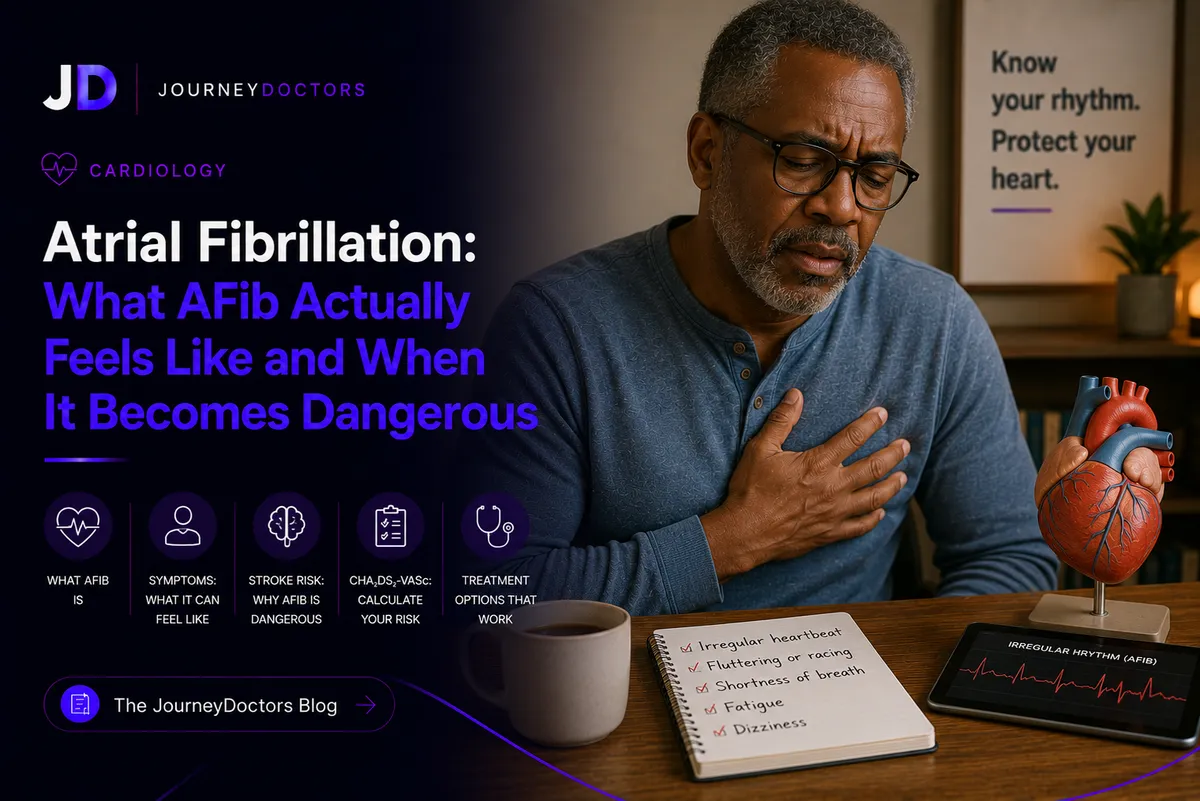
Atrial fibrillation, commonly called AFib, is the most common sustained cardiac arrhythmia, affecting an estimated 6.1 million Americans and projected to reach 12.1 million by 2030 as the population ages. It occurs when the electrical signals in the upper chambers of the heart (the atria) fire chaotically instead of in a coordinated rhythm, causing the atria to quiver rapidly and irregularly rather than contracting effectively. The result is an irregular, often fast heartbeat that can feel like fluttering, pounding, racing, or an unsettling sense of the heart stumbling. The danger of AFib is not primarily the palpitation itself — many people live with it for years — but the conditions it creates for stroke. Blood that pools in a fibrillating atrium, particularly in a pouch called the left atrial appendage, can clot. If that clot travels to the brain, it causes a stroke. AFib accounts for 15 to 20 percent of all ischemic strokes, and AFib-related strokes tend to be larger and more disabling than strokes from other causes.
What AFib Actually Feels Like
Symptoms vary enormously between individuals, and the variability is clinically important. Some people experience AFib as dramatic and frightening: a racing, flopping sensation in the chest, shortness of breath at rest, dizziness, weakness, or near-fainting. Others notice nothing at all — their AFib is discovered incidentally on an EKG taken for an unrelated reason, or detected by a smartwatch. Both presentations are real and both carry meaningful risk.
The most commonly reported symptoms include:
- Palpitations: A sensation of the heart fluttering, racing, flip-flopping, or beating irregularly. Many patients describe feeling their heart "skip beats" or pound unusually hard.
- Fatigue: One of the most consistent and underappreciated symptoms. The atria's failure to contract efficiently reduces cardiac output by up to 20–30%, leaving many patients with unexplained exhaustion, reduced exercise tolerance, or breathlessness with activities that previously felt easy.
- Shortness of breath: Particularly during exertion or when lying flat, as reduced cardiac efficiency impairs the heart's ability to meet oxygen demands.
- Dizziness or lightheadedness: Can accompany rapid ventricular rates when the disorganized atrial signals drive the ventricles too fast.
- Chest discomfort: A pressure, tightness, or ache. When this is present, ruling out coronary artery disease as a concurrent or triggering condition is important.
- Reduced exercise capacity: Many patients describe this as the first sign they noticed in retrospect — they simply could not keep up the way they used to.
A significant minority of AFib patients — estimates range from 10 to 40 percent — are entirely asymptomatic. These individuals carry the same stroke risk as symptomatic patients, which is why AFib screening in appropriate populations matters.
The Three Types: Paroxysmal, Persistent, and Permanent
Cardiologists classify AFib by its temporal pattern, which informs treatment decisions:
Paroxysmal AFib
Episodes begin and end spontaneously, typically lasting less than 7 days (most episodes resolve within 48 hours). The heart returns to normal sinus rhythm on its own. Paroxysmal AFib can still cause stroke — it doesn't need to be constant to form clots. Over time, paroxysmal AFib frequently progresses to persistent or permanent forms in the absence of treatment.
Persistent AFib
Episodes last more than 7 days and do not self-terminate. Restoration of normal sinus rhythm requires medical intervention — either electrical cardioversion (a controlled electrical shock to reset the heart's rhythm) or pharmacological cardioversion using antiarrhythmic drugs. Long-standing persistent AFib is defined as continuous AFib lasting more than 12 months.
Permanent AFib
A clinical designation that applies when both the patient and physician have decided that rhythm restoration is no longer being pursued. The focus shifts to rate control and stroke prevention rather than returning to sinus rhythm. This is not a fixed biological state — the decision can be revisited.
Why AFib Causes Stroke: Understanding the Mechanism
JourneyDoctors
Not sure if this applies to you?
Describe your symptoms to Dr. Maya — our AI GP — and get a real clinical response in under a minute. Free to start.
Talk to Dr. MayaWhen the atria fibrillate instead of contract, blood flow through them becomes turbulent and stagnant rather than propulsive. The left atrial appendage — a small ear-shaped pouch in the left atrium — is particularly prone to blood pooling. Stagnant blood clots, and clots that form here can be ejected into the systemic circulation when the heart beats. If a clot travels to a cerebral artery, it causes a cardioembolic stroke.
AFib increases stroke risk by approximately 4 to 5 times compared to people without AFib. The risk is not uniform — it depends on individual characteristics captured by a clinical scoring system.
The CHA₂DS₂-VASc Score: Quantifying Your Stroke Risk
The CHA₂DS₂-VASc score is the standard tool cardiologists use to estimate annual stroke risk in patients with non-valvular AFib and guide anticoagulation decisions. Each letter represents a risk factor:
- C — Congestive heart failure (1 point)
- H — Hypertension (1 point)
- A₂ — Age ≥75 years (2 points)
- D — Diabetes mellitus (1 point)
- S₂ — Stroke or TIA history (2 points)
- V — Vascular disease (prior MI, peripheral artery disease, or aortic plaque) (1 point)
- A — Age 65–74 years (1 point)
- Sc — Sex category female (1 point)
Maximum score is 9. A score of 0 in men (1 in women) generally does not require anticoagulation. A score of 2 or more in men (3 or more in women) carries sufficient stroke risk to warrant anticoagulation in most patients, weighing bleeding risk. A score of 1 in men (2 in women) is a gray zone requiring individualized discussion.
Annual stroke rates: score 0 corresponds to approximately 0.2% per year; score 2 corresponds to approximately 2.2%; score 6 corresponds to approximately 9.8%. These numbers justify the use of blood-thinning medication despite its own risks.
Anticoagulation: Blood Thinners for Stroke Prevention
Anticoagulation (blood thinners) is the cornerstone of stroke prevention in AFib. The options:
Direct Oral Anticoagulants (DOACs)
Drugs such as apixaban (Eliquis), rivaroxaban (Xarelto), dabigatran (Pradaxa), and edoxaban (Savaysa) are now preferred over warfarin for non-valvular AFib in most patients. They have consistent efficacy, a more predictable anticoagulant effect, no need for frequent INR blood monitoring, fewer dietary interactions, and in most cases a lower risk of intracranial hemorrhage compared to warfarin. Kidney function must be checked before initiating DOACs and monitored periodically, as impaired clearance can cause drug accumulation.
Warfarin (Coumadin)
The traditional oral anticoagulant, still appropriate in certain situations — particularly in patients with mechanical heart valves or moderate-to-severe mitral stenosis, where DOACs are not indicated. Requires regular INR monitoring to maintain a therapeutic range of 2.0 to 3.0.
Left Atrial Appendage Closure
The Watchman device is an implantable closure device that seals off the left atrial appendage, eliminating the primary clot-forming site in AFib. It is an option for patients with high stroke risk who have contraindications to long-term anticoagulation, such as a history of major bleeding.
Rate Control vs. Rhythm Control
Once AFib is diagnosed, treatment strategy centers on two approaches that address different aspects of the condition.
Rate Control
Rate control means accepting that AFib continues but slowing the ventricular rate to a target generally below 110 beats per minute at rest (lenient control) or below 80 bpm (strict control). Beta-blockers (metoprolol, carvedilol), calcium channel blockers (diltiazem, verapamil), and digoxin are the main agents. Rate control alone is appropriate for many patients, particularly older adults with minimal symptoms, and was shown in the landmark AFFIRM trial to produce outcomes comparable to rhythm control in terms of mortality and stroke risk in a broad population.
Rhythm Control
Rhythm control attempts to restore and maintain normal sinus rhythm. Tools include electrical cardioversion (DC cardioversion) — a brief, synchronized electrical shock delivered under sedation that resets the heart's rhythm — and antiarrhythmic drugs such as flecainide, propafenone, amiodarone, sotalol, and dofetilide. More recent data from the EAST-AFNET 4 trial suggests that early rhythm control in newly diagnosed AFib reduces the combined risk of cardiovascular death, stroke, and worsening heart failure — shifting practice toward earlier and more aggressive rhythm management, particularly in younger patients or those recently diagnosed.
Catheter Ablation: Targeting the Source
Catheter ablation is a procedure that electrically isolates the pulmonary veins — the primary source of the ectopic signals that trigger AFib in most patients — from the rest of the atrium using radiofrequency energy or cryotherapy. It is most effective in paroxysmal AFib in patients without significant structural heart disease, with success rates of approximately 65–85% for freedom from AFib at one year after a single procedure (rising to 80–90% after repeat procedures). Success rates are lower in persistent or long-standing persistent AFib. The procedure carries a small but real risk of complications including stroke (0.5–1%), pulmonary vein stenosis, esophageal injury, and cardiac tamponade. For appropriate patients, ablation offers better symptom relief and quality of life improvement than antiarrhythmic drug therapy.
Common AFib Triggers
Many AFib episodes have identifiable triggers. Recognizing and managing them is an important but often underemphasized component of care. Established triggers include: excess alcohol (even moderate intake — the "holiday heart" phenomenon after binge drinking is well documented), sleep apnea (a major and underdiagnosed contributor — treating obstructive sleep apnea with CPAP reduces AFib recurrence), excessive caffeine in sensitive individuals, physical and emotional stress, thyroid dysfunction (both hyperthyroidism and hypothyroidism), obesity, and acute illness or surgery. Lifestyle modification — weight loss in obese patients, treatment of sleep apnea, limiting alcohol — has demonstrated meaningful reductions in AFib burden in clinical trials.
When to See a Doctor
If you experience a new irregular heartbeat, unexplained palpitations, sudden shortness of breath, dizziness, or unexplained fatigue — particularly if you have risk factors such as high blood pressure, diabetes, obesity, heart disease, or a family history of AFib — see a physician promptly. A standard EKG can diagnose AFib in minutes, and an extended monitor or wearable can catch paroxysmal episodes that come and go. Do not wait to be seen: an undiagnosed and anticoagulated AFib is one of the most preventable causes of major stroke. JourneyDoctors connects you with trained specialists from $19. Start a consultation today — no waiting room, no referral needed.
This article is for educational purposes only and does not constitute medical advice. Always consult a qualified healthcare professional for diagnosis and treatment.
Get proper care
Ready to speak with a specialist?
If anything in this article sounds familiar, the right next step is a proper evaluation. JourneyDoctors connects you with a specialist in minutes. Consultations from $19.
See a specialist nowFrequently Asked Questions
Can AFib go away on its own?
Paroxysmal AFib episodes do terminate spontaneously, often within hours to a few days. However, "going away" on its own does not eliminate stroke risk — clots can form during even brief episodes. Over time, paroxysmal AFib frequently progresses to persistent or permanent forms. Spontaneous termination of an episode is not a substitute for evaluation and management by a physician.
Is AFib a death sentence?
No. Millions of people live full, active lives with well-managed AFib. The key is appropriate management of stroke risk with anticoagulation and, where indicated, rate or rhythm control. AFib does increase mortality risk modestly — approximately 1.5 to 1.9 times higher than the general population — but this risk is substantially modified by proper treatment. Many patients on anticoagulation with controlled rates have outcomes approaching those of the general population.
Do I need to take blood thinners forever?
For most patients with AFib and a CHA₂DS₂-VASc score of 2 or higher (in men), long-term anticoagulation is recommended. Even if rhythm control is achieved and the heart returns to normal sinus rhythm, the underlying risk of recurrence means anticoagulation is usually continued in higher-risk patients. This is a nuanced, individualized decision that depends on your stroke risk score, bleeding risk, type of AFib, and treatment response.
Can exercise trigger AFib?
Vigorous exercise can trigger AFib episodes in susceptible individuals, and paradoxically, long-term very high-intensity endurance sport is associated with increased AFib risk (sometimes called "athlete's heart" — the structural remodeling from extreme endurance training creates an arrhythmia-prone substrate). Moderate regular exercise, however, has a protective effect — it reduces AFib risk, improves outcomes in patients who have it, and is strongly recommended as part of management.
Does AFib cause chest pain?
AFib can cause chest discomfort, tightness, or pressure, particularly during episodes with rapid ventricular rates. However, chest pain in the setting of AFib requires evaluation to rule out concurrent coronary artery disease, as heart attacks can both trigger AFib and occur alongside it. New or severe chest pain in someone with AFib should always be evaluated promptly — do not assume it is simply the AFib.
Written by
Dr. Adaeze Nwosu
Cardiology