

Dehydration in Adults: Symptoms, Severity Levels, and When It Becomes a Medical Emergency
Dehydration in adults occurs in three severity levels — mild, moderate, and severe — each with distinct symptoms and very different management needs. Knowing where you fall on that spectrum determines whether you need a glass of water or an emergency room.
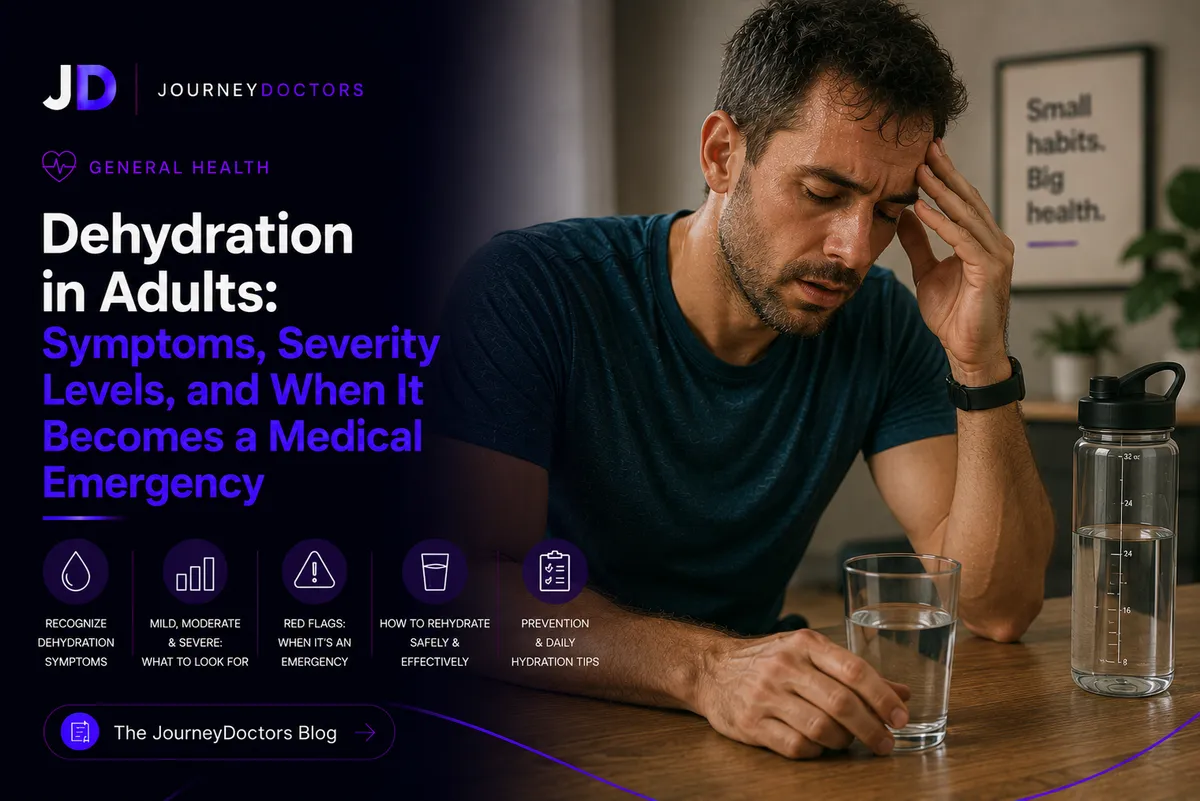
Dehydration in adults is defined as a net loss of body water that exceeds intake, and it presents across three clinically recognized severity levels: mild (1–2% body weight loss), moderate (3–5%), and severe (greater than 5–8%). At the mild end, you feel thirsty and your urine darkens. At the severe end, you may experience confusion, rapid heart rate, and dangerous electrolyte shifts that can become life-threatening. Most healthy adults will never reach severe dehydration from ordinary daily activity, but the risk rises sharply with illness, extreme heat, alcohol, diuretic medications, or when early symptoms are simply ignored. Understanding each level gives you a clear framework for when to drink more water, when to reach for an electrolyte solution, and when to call 911.
How Much Water Do Adults Actually Need?
The familiar "eight glasses a day" rule is a cultural artifact, not a clinical guideline. Current evidence supports an individualized approach. The National Academies of Sciences recommends approximately 3.7 liters (about 125 ounces) of total daily water intake for men and 2.7 liters (about 91 ounces) for women — figures that include water from all foods and beverages, not just plain water. Roughly 20 percent of daily water intake comes from food in a typical diet.
Factors that meaningfully increase requirements include vigorous physical activity, hot or humid environments, fever, diarrhea, vomiting, pregnancy, breastfeeding, and high-altitude environments. A construction worker in July heat and a sedentary person in an air-conditioned office do not have remotely the same hydration needs, despite weighing the same.
Thirst itself is a late indicator. By the time you feel genuinely thirsty, mild dehydration is likely already underway. In adults over 65, this is especially unreliable — the thirst response diminishes with age, so older adults can be significantly fluid-depleted without feeling thirsty at all. Urine color is a more reliable real-time marker for most people.
The Urine Color Chart: Your Hydration Barometer
Urine color reflects the concentration of urochrome, a pigment produced during hemoglobin breakdown. As a practical hydration tool, it correlates well with fluid status:
- Pale yellow to straw (lightest shades): Well hydrated. This is the target.
- Yellow: Adequately hydrated. Acceptable for most of the day.
- Dark yellow: Mildly dehydrated. Drink water now.
- Amber or honey: Moderately dehydrated. Increase fluid intake immediately, especially if symptoms accompany it.
- Brown, dark orange, or cola-colored: Severely dehydrated or potentially signaling kidney stress or muscle breakdown (rhabdomyolysis). Seek medical attention.
Important caveat: B-vitamin supplements turn urine a vivid yellow regardless of hydration. Beets can produce pink or red urine. Certain medications alter color. Interpret urine color alongside how you feel, not in isolation.
Mild Dehydration: Symptoms and What to Do
JourneyDoctors
Not sure if this applies to you?
Describe your symptoms to Dr. Maya — our AI GP — and get a real clinical response in under a minute. Free to start.
Talk to Dr. MayaMild dehydration represents a fluid deficit of roughly 1–2% of body weight. For a 180-pound adult, that is approximately 1.8 to 3.6 pounds of fluid — less than two large water bottles' worth. Despite the modest volume, this is physiologically significant.
Symptoms at this level include increased thirst, slightly darker urine, dry mouth, mild headache, reduced concentration, and a sense of fatigue or low energy that many people wrongly attribute to hunger or poor sleep. Research from the University of Connecticut demonstrated that mild dehydration of just 1.36% impaired mood, increased perceived difficulty of tasks, and worsened concentration — even in the absence of physical exertion. Similar results emerged in men at 1.59% dehydration. These are not dramatic symptoms, which is exactly why mild dehydration often goes unaddressed for hours.
Management is simple: drink water steadily. In most adults without complicating factors, plain water corrects mild dehydration within 30 to 60 minutes. Electrolyte replacement is typically not necessary unless the dehydration stems from significant sweating, vomiting, or diarrhea rather than simple inadequate intake.
Moderate Dehydration: Symptoms and When to Add Electrolytes
Moderate dehydration represents a 3–5% fluid deficit. At this level, physiological compensation becomes visible. The body begins restricting blood flow to peripheral tissues to maintain central circulation — which is why the skin may look pale or feel cool and clammy even in a warm environment.
Symptoms include decreased urination frequency (fewer than three to four times per day), dry cracked lips, a worsening headache, dizziness especially upon standing (orthostatic hypotension from falling blood pressure), muscle cramps, and pronounced fatigue. Cognitive performance deteriorates noticeably — a 2% fluid deficit measurably impairs reaction time, short-term memory, and attention. In older adults and young children, moderate dehydration develops faster because of differences in body composition and reduced thirst sensitivity.
Management at this level should include an electrolyte solution rather than plain water alone. Active sweating, vomiting, or diarrhea depletes sodium, potassium, and chloride. Drinking only plain water when these electrolytes are low can paradoxically worsen a condition called dilutional hyponatremia — low blood sodium from water excess. The World Health Organization oral rehydration formula contains 2.6 g sodium chloride, 1.5 g potassium chloride, 2.9 g trisodium citrate, and 13.5 g glucose per liter, a composition engineered to maximize intestinal absorption via the sodium-glucose co-transporter.
Severe Dehydration: Symptoms and When to Go to the ER
Severe dehydration is a medical emergency. It begins at approximately a 5–8% fluid loss and becomes life-threatening above 10%. At this stage, the compensatory mechanisms that protected central circulation begin to fail.
Emergency symptoms include: no urination for eight or more hours, sunken eyes, skin that tents when pinched and does not spring back (poor skin turgor), rapid heart rate (tachycardia above 100 beats per minute at rest), low blood pressure (systolic below 90 mmHg), confusion or altered mental status, rapid shallow breathing, extreme weakness, and in the most severe cases, unconsciousness or seizures.
If you or someone near you is showing confusion, rapid or irregular heartbeat, inability to keep fluids down, or absence of urination for eight or more hours — go to the emergency department. Attempting to manage severe dehydration orally delays treatment that can be critical. Standard IV resuscitation uses isotonic solutions such as normal saline (0.9% sodium chloride) or lactated Ringer's, administered at rates determined by clinical assessment of hemodynamic status.
Electrolytes: Why They Matter Beyond "Stay Hydrated"
Electrolytes are minerals that carry electrical charge in body fluids. The primary players in dehydration are sodium, potassium, chloride, and bicarbonate. They regulate fluid distribution across cell membranes, enable nerve signal transmission, and drive muscle contraction — including, critically, heart muscle contraction.
Sodium is the dominant extracellular electrolyte and the one most directly affected by dehydration. Normal serum sodium is 136–145 mEq/L. When dehydration is severe, sodium concentration rises above this range — a condition called hypernatremia. Conversely, drinking excessive amounts of plain water without sodium replacement — a real risk in endurance athletes — can cause hyponatremia (sodium below 135 mEq/L), which carries its own neurological risks including cerebral edema and seizure.
Hypernatremia: When Dehydration Becomes a Sodium Emergency
Hypernatremia (serum sodium above 145 mEq/L) is a potentially serious complication that develops when dehydration is severe or prolonged. As extracellular sodium concentration rises, water is drawn out of brain cells by osmotic pressure, causing neuronal shrinkage. This produces a symptom spectrum: early irritability and lethargy, progressing to muscle twitching, seizures, and — in extreme cases — rupture of cerebral bridging veins causing intracranial hemorrhage.
Hypernatremia is most common in elderly patients with impaired thirst response, infants, and critically ill patients who cannot take fluid orally. Sodium above 155 mEq/L warrants urgent hospital-based management. Treatment requires careful gradual sodium correction over 24–48 hours — lowering it too quickly causes cerebral edema as water rushes back into brain cells, which can cause its own set of neurological complications.
Chronic Mild Dehydration: The Slow Drain Most People Never Address
Many adults exist in a state of chronic low-grade dehydration without recognizing it. Surveys consistently show that Americans consume only 60–70% of recommended daily fluid intake. The consequences are not acute emergencies, but they accumulate over time.
Chronic mild underhydration is linked to a significantly increased risk of kidney stones — urine output below 1 liter per day raises urinary mineral concentration to stone-forming levels, while output above 2 liters substantially reduces risk. It is also associated with increased risk of urinary tract infections, chronic constipation, reduced physical performance, and impaired cognitive function. Some epidemiological evidence links low chronic fluid intake to higher rates of bladder cancer and colon cancer, though the mechanisms are still being investigated.
The fix is habit, not heroics. Drinking with every meal, carrying a water bottle, and periodically checking urine color are simple calibration tools that prove highly effective when made consistent.
When to See a Doctor
Seek emergency care immediately if you experience confusion or disorientation, no urination for more than eight hours, rapid or irregular heartbeat, inability to retain fluids due to vomiting, severe dizziness or fainting, or if the affected person is an infant, elderly adult, or someone with kidney disease, heart failure, or uncontrolled diabetes. For non-emergency concerns — recurrent dehydration despite adequate intake, frequent kidney stones, or persistent fatigue with normal urine color — a physician can assess electrolyte balance with a basic metabolic panel and help you understand your specific needs. JourneyDoctors connects you with trained specialists from $19. Start a consultation today — no waiting room, no referral needed.
This article is for educational purposes only and does not constitute medical advice. Always consult a qualified healthcare professional for diagnosis and treatment.
Get proper care
Ready to speak with a specialist?
If anything in this article sounds familiar, the right next step is a proper evaluation. JourneyDoctors connects you with a specialist in minutes. Consultations from $19.
See a specialist nowFrequently Asked Questions
Can you be dehydrated even if you're drinking water regularly?
Yes. Dehydration can occur despite regular water intake if losses from sweating, fever, vomiting, or diarrhea significantly exceed intake. It can also occur if you are drinking plain water but losing substantial electrolytes — particularly sodium — which the body needs to retain fluid in its compartments. Urine color remains the most practical real-time indicator regardless of how much you think you are drinking.
What is the fastest way to rehydrate?
For mild dehydration, drinking water steadily at about 8 ounces every 15 to 20 minutes is more effective than gulping large volumes at once, which can cause nausea. For moderate dehydration with electrolyte loss, an oral rehydration solution absorbs faster than plain water due to the sodium-glucose co-transport mechanism in the intestinal wall. Severe dehydration requires IV fluid replacement, which bypasses the gut entirely and corrects deficits in hours.
Does coffee dehydrate you?
Despite caffeine's mild diuretic effect, research is clear that coffee and tea in normal amounts provide a net positive contribution to daily fluid intake. The volume of fluid in a typical cup of coffee exceeds the diuretic effect in habitual consumers. Alcohol, by contrast, is a genuine diuretic and should not be counted toward hydration — it suppresses the hormone vasopressin, causing the kidneys to excrete water at an accelerated rate.
How does dehydration affect blood pressure?
Dehydration reduces circulating blood volume, which lowers blood pressure. This manifests most noticeably as orthostatic hypotension — a drop in systolic pressure of 20 mmHg or more when standing from a seated or lying position — producing dizziness, lightheadedness, or briefly blurred vision. Severe dehydration can progress to frank hypotension and circulatory shock, which is a life-threatening emergency requiring IV fluids.
Are sports drinks better than water for rehydration?
For everyday hydration and mild dehydration from insufficient fluid intake, plain water is entirely adequate. Sports drinks become genuinely beneficial when fluid and electrolyte losses are significant — sustained exercise over 60 minutes in the heat, illness with vomiting or diarrhea, or heavy outdoor labor. In those contexts, the sodium in a sports drink accelerates absorption and retention more effectively than water alone. For gastrointestinal illness, purpose-made oral rehydration solutions (like Pedialyte) are better than commercial sports drinks because they have more sodium and less sugar.
Written by
Dr. Maya Ellis
General Practice