

Hyperpigmentation and Dark Spots: Every Treatment From Topicals to Lasers
Hyperpigmentation is one of the most common and most undertreated skin concerns. Understanding the type you have determines which treatments actually work and which can make things worse.
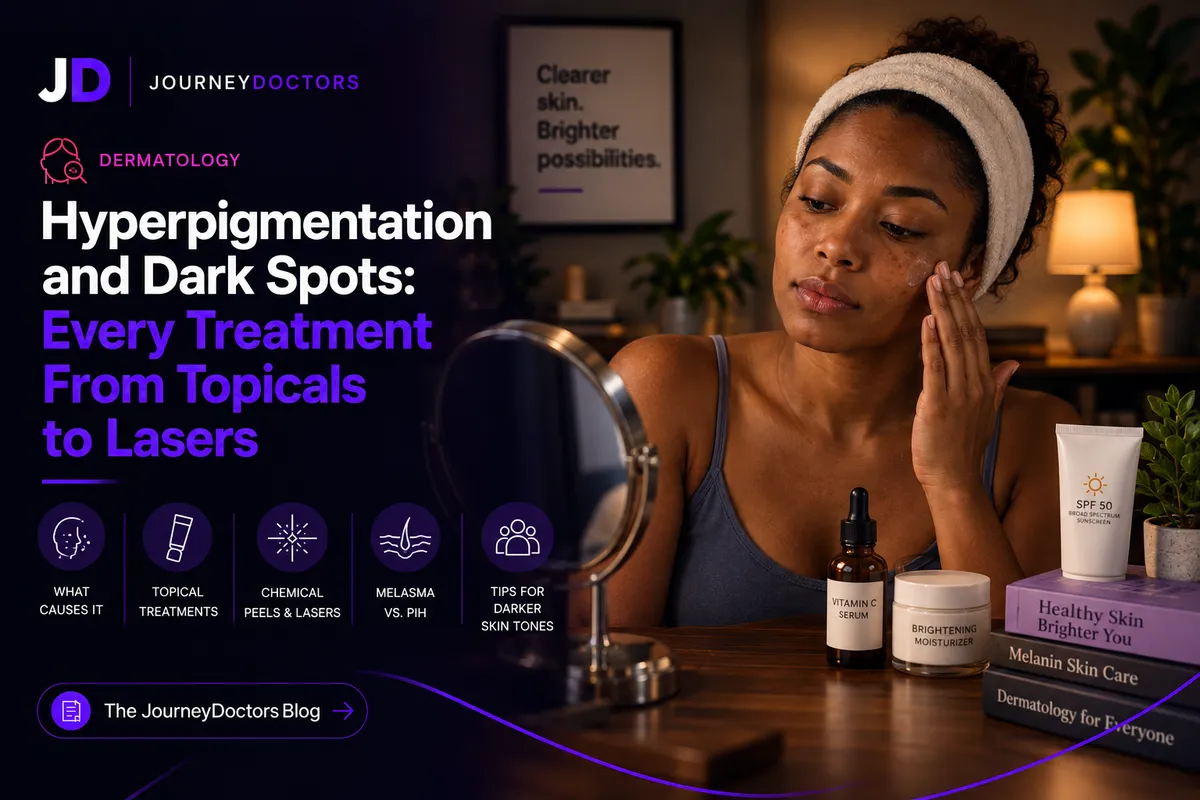
Hyperpigmentation — the umbrella term for patches of skin that are darker than the surrounding area — affects people of every skin tone and is one of the most common concerns dermatologists see. Yet it is also one of the most frequently mistreated, because the type of hyperpigmentation matters enormously for which interventions help and which can cause lasting harm. The right approach to melasma is different from the right approach to post-inflammatory hyperpigmentation or solar lentigines, and treatments that are safe and effective on fair skin can cause significant worsening in darker skin tones if used incorrectly. This guide covers the biology, the subtypes, and the full evidence-based treatment spectrum — topicals, chemical peels, and lasers — with the specificity that a dermatologist would apply in consultation.
How Hyperpigmentation Develops: The Melanin Mechanism
All hyperpigmentation ultimately involves excess melanin — the pigment produced by melanocytes in the basal layer of the epidermis. Melanocytes produce melanin in organelles called melanosomes, which are then transferred to surrounding keratinocytes and distributed throughout the skin. The trigger for excess melanin production varies by condition: UV radiation is the most powerful stimulus, activating melanocytes directly and upregulating the enzyme tyrosinase, which is the rate-limiting step in melanin synthesis. Inflammation activates melanocytes through prostaglandins and other mediators, explaining post-inflammatory hyperpigmentation. Hormonal signals — particularly estrogen and progesterone — stimulate melanogenesis, explaining melasma's association with pregnancy and hormonal contraception. Understanding the trigger helps explain why sunscreen is the foundation of every hyperpigmentation treatment protocol regardless of what else is being used.
Types of Hyperpigmentation
Melasma
Melasma presents as symmetric, irregular brown to gray-brown patches on sun-exposed areas, most commonly the cheeks, forehead, upper lip, chin, and forearms. It affects women in approximately 90 percent of cases, is more prevalent in people with Fitzpatrick skin types III through VI, and is strongly associated with hormonal triggers: pregnancy ("chloasma" or "the mask of pregnancy"), combined oral contraceptives, and intrauterine devices releasing progestogen. Melasma is chronic and prone to relapse with sun exposure or hormonal changes. Histologically, it can be epidermal (more responsive to treatment), dermal (pigment deposited deeper, less responsive), or mixed. A Wood's lamp examination in a dark room helps distinguish epidermal from dermal involvement in lighter skin, though it is less reliable in darker skin types.
Post-Inflammatory Hyperpigmentation (PIH)
PIH occurs after skin injury or inflammation — acne, eczema, psoriasis, contact dermatitis, procedures, or burns. The inflammatory response activates melanocytes, leaving a dark mark at the site of the original lesion. PIH is significantly more pronounced and more persistent in Fitzpatrick skin types IV through VI; for many people with darker skin, it is the most distressing sequela of acne, often more bothersome than the acne itself. PIH will fade spontaneously over months to years without treatment if the triggering inflammation is controlled, but treatment accelerates resolution.
Solar Lentigines
Solar lentigines (commonly called age spots or liver spots) are flat, uniformly tan to brown, well-demarcated spots on chronically sun-exposed skin, appearing most commonly on the face, backs of hands, forearms, and chest. They are the result of years of cumulative UV exposure and are essentially benign. They should be distinguished from lentigo maligna (a form of melanoma in situ) and seborrheic keratoses; any lesion that is changing in size, shape, or color or is irregular should be evaluated by a dermatologist.
Freckles (Ephelides)
Freckles are small, flat, red to light brown spots distributed on sun-exposed skin, most common in fair-skinned individuals with a genetic predisposition (associated with the MC1R gene). Unlike solar lentigines, freckles typically appear in childhood and fade with reduced sun exposure. They require no treatment from a medical standpoint, though many people prefer to reduce their appearance.
SPF: The Non-Negotiable Foundation
JourneyDoctors
Not sure if this applies to you?
Describe your symptoms to Dr. Maya — our AI GP — and get a real clinical response in under a minute. Free to start.
Talk to Dr. MayaSunscreen is not an adjunct to hyperpigmentation treatment — it is the foundation without which no other treatment works adequately. UV radiation is the primary driver of melanocyte activation, and without daily, adequate photoprotection, topical brightening agents and procedures are fighting an uphill battle. The standard recommendation is broad-spectrum SPF 30 or higher, applied every morning regardless of weather, and reapplied every two hours with sun exposure. For melasma and PIH specifically, SPF 50 is preferred. Tinted sunscreens with iron oxides provide protection against visible light, which is an independent driver of melasma and is not blocked by traditional UV filters — an important consideration for melasma patients who work indoors under fluorescent or LED lighting.
Topical Treatments
Hydroquinone
Hydroquinone is the most studied topical depigmenting agent and for decades was the standard of care. It works by inhibiting tyrosinase and by its cytotoxic effects on melanocytes. Concentrations of 2 percent are available over the counter in the US; 4 percent requires a prescription. Clinical trial evidence supports significant improvement in melasma and PIH with consistent use over 8 to 12 weeks. Concerns about hydroquinone center on a side effect called ochronosis — paradoxical skin darkening with a bluish-gray discoloration — which occurs primarily with prolonged, high-concentration, or high-frequency use and is more common in darker skin types. Most dermatologists recommend limiting continuous use to three to six months. Hydroquinone should not be used during pregnancy.
Azelaic Acid
Azelaic acid at 15 to 20 percent concentration is a well-tolerated, evidence-based option that inhibits tyrosinase and has anti-inflammatory and mild comedolytic properties. It is FDA-approved for both acne and rosacea, making it particularly useful when those conditions coexist with PIH. Azelaic acid is safe in pregnancy and is an excellent alternative to hydroquinone for patients who are pregnant, concerned about ochronosis, or have sensitive skin. It is generally well tolerated across all Fitzpatrick skin types.
Kojic Acid
Kojic acid, a by-product of fungal fermentation, inhibits tyrosinase through chelation of copper ions essential for the enzyme's function. Evidence supports modest efficacy for melasma, generally inferior to hydroquinone but with a better tolerability profile. It is often combined with other agents (hydroquinone, glycolic acid, vitamin C) in multi-ingredient brightening formulations. Contact sensitization can occur with repeated use.
Tranexamic Acid
Tranexamic acid is an antifibrinolytic agent that reduces melanin synthesis by inhibiting the interaction between keratinocytes and melanocytes mediated through plasminogen activator. Originally used intravenously to reduce surgical bleeding, it was observed to reduce melasma as a side effect, leading to its development as a topical and oral treatment. Topical tranexamic acid at 2 to 5 percent has good evidence for melasma treatment with an excellent safety profile. Oral tranexamic acid (250 mg twice daily) shows high efficacy for melasma in multiple randomized controlled trials, with sustained results at 8 to 12 weeks; the main safety consideration is a theoretical thromboembolic risk, which limits its use in patients with coagulopathy or history of clot.
Vitamin C (Ascorbic Acid)
L-ascorbic acid inhibits tyrosinase and reduces oxidative stress in melanocytes. Concentrations of 10 to 20 percent have evidence for brightening and hyperpigmentation treatment, with additional anti-aging and antioxidant benefits. Stability is a significant challenge — ascorbic acid oxidizes rapidly, turning yellow-orange and losing efficacy, which is why formulation and packaging matter greatly. Vitamin C is best used in the morning under sunscreen, as it enhances UV protection. It is safe across all skin types and is useful as a preventive agent in PIH-prone skin.
Retinoids
Retinoids (tretinoin, adapalene, retinol) accelerate epidermal turnover, promote shedding of pigmented keratinocytes, and downregulate tyrosinase expression. Tretinoin at 0.025 to 0.1 percent has robust evidence for melasma and solar lentigines treatment and is commonly combined with hydroquinone and a mid-potency corticosteroid in triple combination creams (such as Tri-Luma). Retinoids cause initial irritation, peeling, and temporary hypersensitivity that can worsen PIH if not managed carefully; low-and-slow introduction, adequate moisturization, and consistent SPF use are essential, particularly in darker skin types.
Chemical Peels
Chemical peels remove the outer layers of the skin to accelerate pigment clearance and, at deeper levels, stimulate collagen remodeling. Superficial peels (glycolic acid 20 to 70 percent, salicylic acid 20 to 30 percent, mandelic acid, lactic acid) primarily target the epidermis and are appropriate for most skin types with adequate preparation and sun protection. Medium-depth peels (TCA 20 to 35 percent) penetrate into the papillary dermis and can address dermal pigmentation, but carry a significantly higher risk of PIH and are generally approached with caution in Fitzpatrick skin types IV through VI. Salicylic acid peels are particularly suitable for darker skin because of their anti-inflammatory properties, which reduce the risk of post-peel PIH. A series of 4 to 6 superficial peels every 2 to 4 weeks typically produces meaningful improvement in melasma and PIH. Pre-treatment with a bleaching agent for 2 to 4 weeks before chemical peels ("priming") reduces the risk of post-inflammatory pigmentation and improves outcomes.
Laser and Light Treatments
Q-Switched and Picosecond Lasers
Q-switched Nd:YAG and picosecond lasers deliver ultra-short pulses of energy that selectively target melanin in a process called selective photothermolysis, fragmenting melanin granules without damaging surrounding tissue. They are effective for solar lentigines and resistant PIH. Q-switched Nd:YAG at 1064 nm is considered the safest laser option for darker skin types (Fitzpatrick IV-VI) because its wavelength penetrates deeper and is less preferentially absorbed by epidermal melanin, reducing the risk of PIH. Picosecond lasers deliver even shorter pulse durations than Q-switched devices and may produce better outcomes with fewer treatments and lower risk of PIH.
Fractional Lasers
Fractional non-ablative lasers (Fraxel 1550, Clear + Brilliant) and fractional ablative lasers (CO2, erbium) create columns of thermal injury surrounded by untreated skin, enabling rapid healing. They are effective for overall skin rejuvenation and can improve melasma and PIH. However, fractional lasers carry significant risk of PIH in skin types IV through VI and should be used with caution, at lower settings, with appropriate skin preparation and post-procedure care.
IPL (Intense Pulsed Light)
IPL devices emit broad-spectrum light filtered to target hemoglobin and melanin, making them useful for solar lentigines, freckles, and redness. IPL is most effective and safest in Fitzpatrick skin types I through III. In darker skin types, the risk of PIH is substantial and IPL is generally not recommended for hyperpigmentation treatment.
Treatment Priorities for Darker Skin Tones
People with Fitzpatrick skin types IV through VI face a critical challenge: many aggressive treatments that clear pigmentation in fair skin can cause new PIH and worsen overall appearance in darker skin. The safest and most effective approach prioritizes: daily SPF 50 with iron oxides, azelaic acid or tranexamic acid as first-line tyrosinase inhibitors, retinoids introduced slowly, salicylic acid chemical peels, and when lasers are used, the 1064 nm Nd:YAG or picosecond platforms at conservative settings with trained, experienced practitioners. Aggressive peels, IPL, and high-energy fractional lasers in darker skin tones should be approached only by dermatologists with specific expertise in skin of color.
When to See a Doctor
Any new pigmented lesion that is changing, irregular, or uncertain should be evaluated by a dermatologist to rule out melanoma. For hyperpigmentation concerns — melasma, PIH, solar lentigines — a dermatologist can accurately classify the type and depth of pigmentation, design a treatment protocol matched to your skin type, and supervise in-office procedures safely. JourneyDoctors connects you with trained specialists from $19. Start a consultation today — no waiting room, no referral needed.
Disclaimer: This article is for educational purposes only and does not constitute medical advice. Always consult a qualified healthcare professional for diagnosis and treatment.
Get proper care
Ready to speak with a specialist?
If anything in this article sounds familiar, the right next step is a proper evaluation. JourneyDoctors connects you with a specialist in minutes. Consultations from $19.
See a specialist nowFrequently Asked Questions
How long does it take to see results from topical treatments?
Most topical hyperpigmentation treatments require consistent daily use for 8 to 12 weeks before significant improvement is visible, because they work at the level of melanin production and epidermal turnover, which is a slow process. Patience and consistency are essential — sporadic use produces minimal results. Maintenance treatment is also typically needed after the active treatment phase, because triggers like UV exposure and inflammation recur.
Will my dark spots come back after treatment?
Melasma in particular is highly prone to recurrence with sun exposure, hormonal changes, or stopping treatment. It is best thought of as a chronic condition that can be controlled but not cured. Solar lentigines and PIH have a lower recurrence rate but will return with ongoing UV exposure without adequate sun protection. Long-term maintenance with SPF, antioxidants, and low-dose topical brighteners significantly reduces recurrence rates.
Is hydroquinone safe for long-term use?
Most dermatologists recommend limiting continuous hydroquinone use to three to six months to avoid the risk of ochronosis. It can be used in cycles — treating for 3 to 4 months, then pausing for 1 to 2 months using alternative agents, then restarting if needed. When used appropriately at 2 to 4 percent concentrations with sun protection, hydroquinone is safe and effective for most patients.
Can I combine multiple treatments?
Combining treatments that target different steps in the melanin synthesis pathway often produces better results than any single agent alone. Classic combination protocols include hydroquinone with tretinoin and a corticosteroid (triple therapy), or azelaic acid with tranexamic acid and niacinamide. However, combining too many active ingredients simultaneously increases irritation risk, which can paradoxically trigger more PIH. A dermatologist can guide a staged approach that maximizes efficacy while managing tolerability.
Do over-the-counter brightening serums actually work?
Many OTC serums contain ingredients with genuine evidence — niacinamide, vitamin C, kojic acid, tranexamic acid, azelaic acid — but at concentrations that may be lower than those used in clinical trials, and formulations vary widely in stability and absorption. OTC products can produce meaningful improvement for mild hyperpigmentation, but moderate to severe melasma or PIH typically requires prescription-strength agents or in-office procedures to achieve significant clearance. Reviewing the ingredient list for active concentrations is more informative than marketing claims.
Written by
Dr. Priya Sharma
Dermatology