

Intermittent Fasting: Clinical Evidence vs. the Hype
Intermittent fasting produces real metabolic effects. Whether those effects are meaningfully superior to standard caloric restriction for most people is a different question.
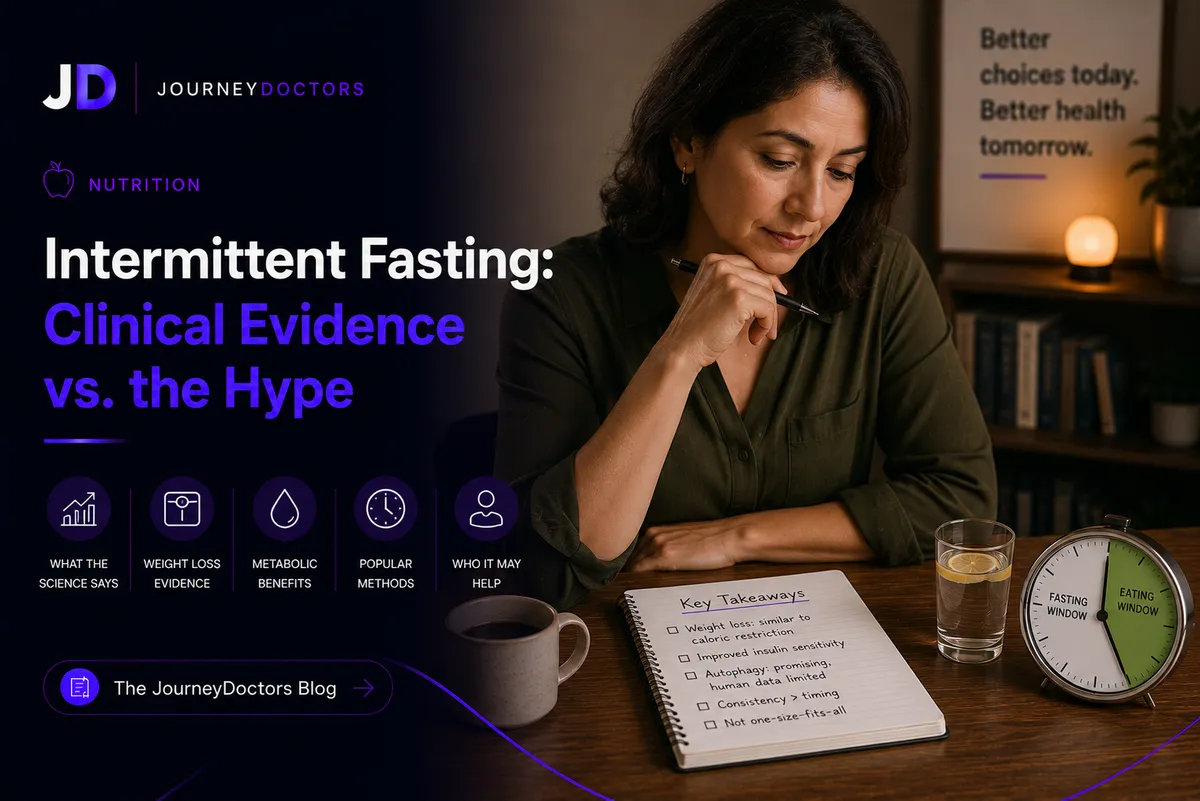
Intermittent fasting is one of the most discussed dietary strategies of the last decade, with a devoted following that credits it with weight loss, metabolic improvement, cancer prevention, and longevity. The clinical evidence is more nuanced. Intermittent fasting works for some outcomes in some people under some conditions. The mechanisms are real. Whether it is superior to other approaches with equivalent caloric deficit is less clear, and the evidence for some of the more dramatic longevity claims is largely extrapolated from animal studies. Here is what the research actually shows.
What Intermittent Fasting Is
Intermittent fasting is not a single diet. It is a category of eating patterns defined by alternating periods of eating and fasting. The major protocols studied in clinical research are: time-restricted eating (TRE), where all eating is confined to a window of 6 to 10 hours per day, typically 16:8 (16 hours fasting, 8 hours eating); alternate-day fasting, where caloric intake is severely restricted (500 calories or less) on alternating days and unrestricted on feeding days; and the 5:2 approach, where severe restriction occurs on two non-consecutive days per week and normal eating on the other five.
Each protocol produces a caloric deficit primarily by reducing the opportunity window for eating, and potentially by influencing appetite hormones and metabolic switching.
The Metabolic Mechanisms
After approximately 12 to 14 hours of fasting, liver glycogen stores are substantially depleted and the body begins shifting toward fat oxidation as its primary fuel source. Ketone production increases. Insulin levels fall. Growth hormone rises. These metabolic changes are proposed to produce benefits beyond what a simple caloric deficit achieves.
Autophagy, the cellular recycling process by which damaged proteins and organelles are broken down and reused, is upregulated during fasting states. This is the mechanism most cited in longevity discussions. The Nobel Prize in Physiology awarded in 2016 recognized the mechanisms of autophagy, and fasting is one of the most reliable inducers. However, the specific duration, frequency, and degree of fasting required to produce clinically meaningful autophagy in humans, and the health outcomes this translates to, are not yet well established in human clinical trials.
Weight Loss: What the Trials Show
JourneyDoctors
Not sure if this applies to you?
Describe your symptoms to Dr. Maya — our AI GP — and get a real clinical response in under a minute. Free to start.
Talk to Dr. MayaMultiple randomized controlled trials have compared intermittent fasting to continuous caloric restriction for weight loss. The consistent finding is that both approaches produce comparable weight loss when total caloric intake is similar. A 2020 NEJM review of the evidence concluded that intermittent fasting produces clinically meaningful weight loss but is not consistently superior to continuous restriction when caloric intake is matched.
The practical advantage of intermittent fasting for many people is adherence. Restricting the eating window or fasting on specific days is a simpler rule to follow than tracking calories daily. For people who find calorie counting burdensome, TRE can produce a natural caloric deficit without explicit tracking. That adherence advantage is real and clinically meaningful even if the mechanism is simply caloric restriction by another name.
Weight loss outcomes are highly variable between individuals and depend heavily on what is eaten during the eating window. Time-restricted eating with a diet high in ultra-processed foods during the feeding window does not produce the same results as TRE with whole foods. The eating window determines when you eat; dietary quality determines what happens during it.
Metabolic Health
Beyond weight, intermittent fasting has been studied for effects on insulin sensitivity, fasting glucose, blood pressure, lipids, and inflammatory markers. The evidence shows consistent improvement in these markers, but again, the improvement is largely comparable to what equivalent caloric restriction and weight loss produce regardless of the pattern. In other words, losing 5% of body weight through any sustainable dietary approach will improve insulin sensitivity and metabolic markers. Whether the fasting pattern itself adds benefit beyond the weight loss is less clear.
Some studies, including a well-designed trial by Sutton and colleagues in 2018, showed that early time-restricted eating (eating from 8am to 2pm) improved insulin sensitivity, blood pressure, and oxidative stress in men with prediabetes independent of weight loss. This suggests there may be circadian metabolic effects of aligning eating with daylight hours that go beyond caloric restriction, though the practical feasibility of eating all meals before 2pm limits this protocol for most people.
Who It Works Best For
Intermittent fasting appears to work best for people who naturally have low appetite in the morning and find it easy to skip breakfast, people who benefit from simple rules rather than calorie tracking, and people who tend to overeat in the evening (since TRE specifically limits late eating).
It is less suitable for people with a history of disordered eating, where restrictive frameworks can be harmful. It requires careful management in people with diabetes on insulin or sulfonylureas, where prolonged fasting can cause hypoglycemia. Pregnant and breastfeeding women should not use intermittent fasting. People with a history of eating disorders should discuss any restrictive eating approach with a clinician or therapist before starting.
The Longevity Claims
The longevity claims associated with intermittent fasting, including extended lifespan, cancer prevention, and reversal of aging, are primarily based on animal studies, particularly in rodents and simpler organisms. The translation of these findings to humans is not established. Caloric restriction in rodents can extend lifespan by 30 to 40%. In primates, the evidence is more mixed. In humans, we do not have the longitudinal data to make strong claims about lifespan.
This does not mean fasting has no longevity-relevant effects. Improved insulin sensitivity, reduced inflammatory markers, weight loss, and reduced cardiovascular risk are all associated with longer healthspan, and intermittent fasting can produce all of these. But the specific mechanism of autophagy-mediated longevity extension in humans from a 16:8 eating window has not been demonstrated in clinical trials.
How to Start
If you want to try intermittent fasting, the 16:8 protocol is the most extensively studied and the most practical to implement. Choose an eating window that works with your schedule — most people find 12pm to 8pm the most sustainable. During the fasting window, water, black coffee, and plain tea are permitted and do not break the fast. During the eating window, the same principles of dietary quality apply as any other approach: minimize ultra-processed foods, prioritize protein, vegetables, fiber, and whole grains.
Give it four to six weeks before evaluating results. The first one to two weeks often involve adjustment symptoms including hunger, irritability, and reduced concentration that typically resolve as the body adapts to the new eating pattern.
When to See a Doctor
If you have diabetes, are on medications that require food, have a history of eating disorders, or have other chronic conditions, discuss intermittent fasting with a clinician before starting. A JourneyDoctors physician can review your health history, advise on whether intermittent fasting is appropriate for you, and help you think through the approach that best fits your goals and circumstances.
Disclaimer: This article is for educational purposes only and does not constitute medical advice. Always consult a qualified healthcare professional before making significant dietary changes.
Get proper care
Ready to speak with a specialist?
If anything in this article sounds familiar, the right next step is a proper evaluation. JourneyDoctors connects you with a specialist in minutes. Consultations from $19.
See a specialist nowFrequently Asked Questions
Does coffee break a fast?
Black coffee does not meaningfully break a metabolic fast. It contains negligible calories, does not raise insulin levels significantly, and may actually support fat oxidation through caffeine's effects. Coffee with milk, cream, or sugar does add calories and will partially interrupt the fasted metabolic state. Plain black coffee or tea during the fasting window is generally considered acceptable within TRE protocols.
Will I lose muscle on intermittent fasting?
Muscle loss during any caloric deficit is a risk, not a certainty. Adequate protein intake (0.7 to 1g per pound of body weight) and resistance training substantially reduce muscle loss during weight loss regardless of the dietary approach. Intermittent fasting does not appear to cause disproportionate muscle loss compared to continuous caloric restriction when protein intake is sufficient.
Is 16:8 better than 14:10?
The evidence does not establish a clear superiority of more restrictive fasting windows over less restrictive ones. A 14:10 window is more sustainable for many people and still produces a meaningful reduction in eating opportunity. Starting with a 14:10 window and adjusting based on how you feel and your results is a reasonable approach.
Can intermittent fasting help with insulin resistance?
Yes, particularly when it results in weight loss. Reduced insulin levels during the fasting state and the metabolic switch to fat oxidation both improve insulin sensitivity over time. However, equivalent improvements are seen with other dietary approaches that produce similar weight loss. The fasting pattern may add incremental benefit through circadian alignment effects, but this is not yet definitively established.
How do I know if intermittent fasting is working?
Practical markers include gradual weight loss (0.5 to 1 pound per week is a sustainable rate), improved energy levels after the initial adaptation period, and if you have relevant lab values, improvement in fasting glucose and HbA1c at your next check. If you are losing weight faster than 1 to 1.5 pounds per week consistently, you are in too aggressive a caloric deficit and risk muscle loss and metabolic adaptation.
Written by
Dr. James Okafor
Internal Medicine