

Sleep Deprivation Is a Medical Problem. Here Is What It Does to Your Body.
Most adults need seven to nine hours of sleep. If you are consistently getting less, your body is running a deficit that accumulates in ways you cannot feel until the damage is done.
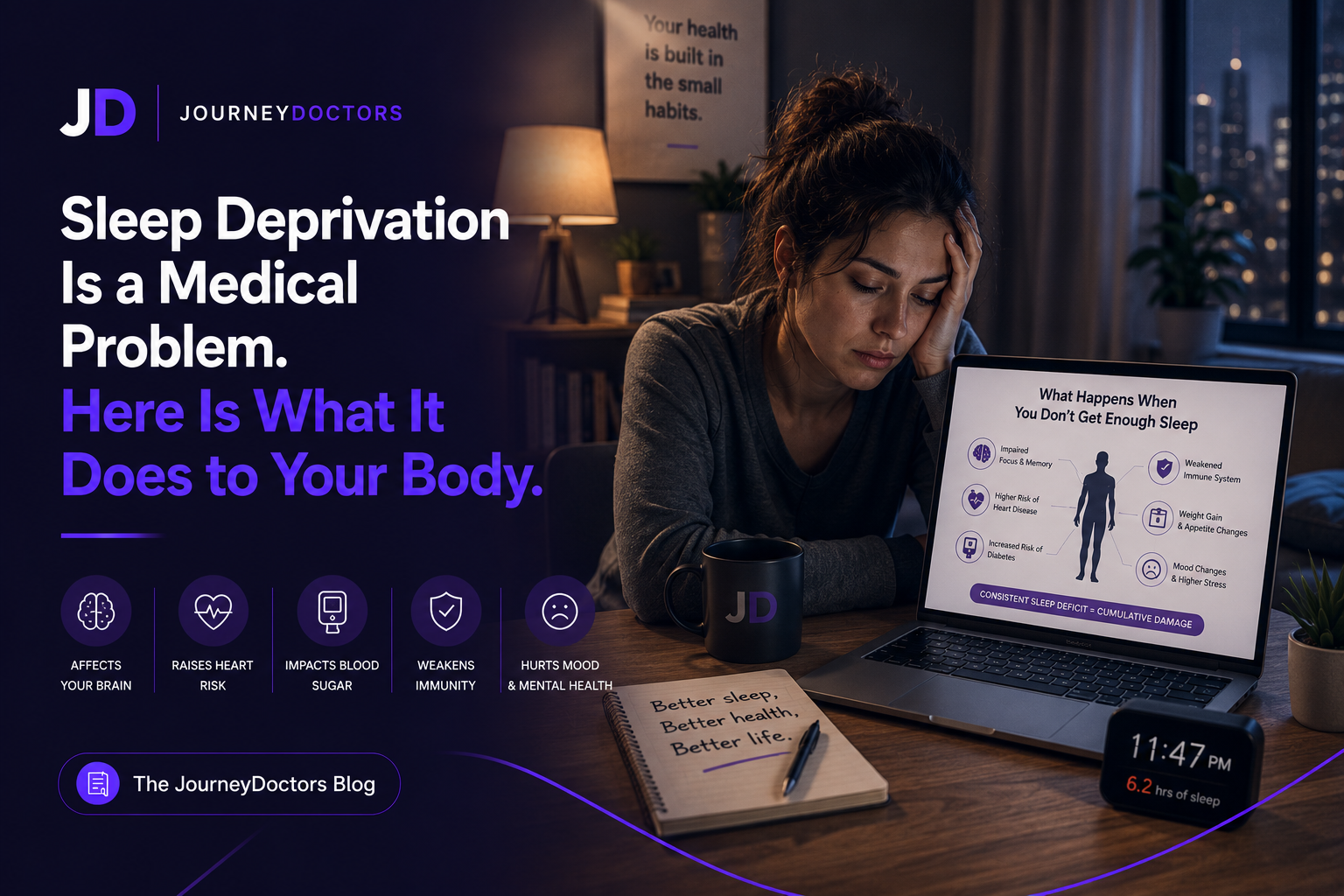
Sleep deprivation is not a personality trait or a badge of productivity. It is a physiological state that systematically impairs nearly every organ system in the body. As an internist, I treat the downstream consequences of chronic poor sleep regularly: worsening blood pressure, unexplained weight gain, deteriorating blood sugar control, recurrent infections, and depression that does not fully respond to treatment. In most of these patients, sleep is an afterthought. It should be the first thing we address.
The evidence on sleep and health is no longer ambiguous. The World Health Organization has declared inadequate sleep a global public health epidemic. Adults who consistently sleep fewer than six hours per night have measurably higher rates of cardiovascular disease, type 2 diabetes, obesity, and all-cause mortality than those who sleep seven to nine hours. This is not a small effect. The magnitude of risk rivals smoking a small number of cigarettes per day.
What Sleep Actually Does
Sleep is not passive downtime. It is one of the most metabolically active periods of the day. During sleep, your brain clears waste products through the glymphatic system, a network of channels that flushes out proteins including beta-amyloid, which accumulates in Alzheimer's disease. Your immune system consolidates its response to pathogens encountered during the day. Your body regulates hormones that control appetite, stress response, and tissue repair. Your cardiovascular system gets its longest period of lower demand, allowing blood pressure and heart rate to fall into a restorative range.
Disrupting this process consistently does not just make you feel tired. It interferes with all of these functions simultaneously.
What Happens to Your Brain
Cognitive impairment from sleep deprivation is well-documented and begins quickly. After 17 to 19 hours without sleep, reaction time and decision-making decline to a level equivalent to a blood alcohol concentration of 0.05 percent, which is above the legal driving limit in some countries. After 24 hours, cognitive performance drops to the equivalent of legal intoxication in most jurisdictions.
The subjective experience of this impairment is unreliable. One of the most consistent findings in sleep research is that sleep-deprived individuals dramatically underestimate their own impairment. You feel more alert than you are. This is why chronically sleep-deprived people believe they have adapted when, in fact, their baseline performance has simply declined to a new normal.
In the long term, chronic sleep deprivation accelerates cognitive aging. Studies using brain imaging have shown that people who sleep fewer than six hours per night show faster rates of cortical thinning than adequate sleepers of the same age. The mechanism almost certainly involves impaired glymphatic clearance of neurotoxic waste products during sleep.
What Happens to Your Heart
JourneyDoctors
Not sure if this applies to you?
Describe your symptoms to Dr. Maya — our AI GP — and get a real clinical response in under a minute. Free to start.
Talk to Dr. MayaThe cardiovascular system is particularly vulnerable to insufficient sleep. A large-scale analysis of data from over 400,000 people found that short sleep duration (under six hours) was associated with a 20 percent higher risk of a heart attack and a 15 percent higher risk of stroke compared to seven to eight hours of sleep.
The mechanisms are multiple. Sleep deprivation increases sympathetic nervous system activity, raising resting heart rate and blood pressure. It elevates circulating inflammatory markers including C-reactive protein and interleukin-6, which accelerate arterial plaque formation. It disrupts the normal nocturnal dip in blood pressure that the heart depends on for recovery. People who lack this nocturnal dip, which can be identified on ambulatory blood pressure monitoring, have significantly higher rates of cardiovascular events even if their daytime blood pressure appears controlled.
If you have hypertension and your blood pressure is difficult to control despite medication, poor sleep is one of the first things I will ask about.
What Happens to Your Metabolism
The hormonal consequences of sleep deprivation directly drive weight gain and metabolic disease. After even a single night of poor sleep, levels of ghrelin, the hormone that increases appetite, rise significantly. Levels of leptin, the hormone that signals satiety, fall. The result is that you feel hungrier and it takes more food to feel full, independent of actual caloric need.
Beyond appetite, sleep deprivation impairs insulin sensitivity. Research has shown that after six nights of sleeping four hours, healthy young adults developed insulin resistance comparable to pre-diabetic levels. This effect reverses when sleep is restored, which is both encouraging and illustrative of how directly sleep governs metabolic function.
The combination of increased appetite, impaired satiety signaling, reduced energy for exercise, and worsened insulin sensitivity makes chronic short sleep one of the most underappreciated contributors to the obesity epidemic. Addressing sleep is not optional in weight management. It is foundational.
What Happens to Your Immune System
Immune function is one of the most immediately measurable casualties of poor sleep. A landmark study gave participants nasal drops containing rhinovirus (the virus that causes the common cold) after monitoring their sleep for two weeks. Those who slept fewer than six hours were 4.2 times more likely to develop a cold than those who slept seven or more hours. This was a dose-response relationship: shorter sleep, higher infection risk.
The mechanism involves reduced production of cytokines, particularly interferon-gamma, during sleep deprivation. Natural killer cell activity, which is the immune system's first line of defense against both viruses and tumor cells, is also significantly suppressed. One study found that a single night of four hours of sleep reduced natural killer cell activity by 70 percent. This recovered after a full night of sleep, which speaks to why catching up on sleep after illness is not just psychologically comforting but genuinely therapeutic.
For patients undergoing cancer treatment, recovering from surgery, or dealing with any chronic infection, sleep quality is not a peripheral concern. It is directly relevant to immune competence.
What Happens to Your Mental Health
The relationship between sleep and mental health is bidirectional but the causal arrow often runs from poor sleep to worsening psychiatric symptoms rather than the other way around. Depression, anxiety, and bipolar disorder all affect sleep, but sleep deprivation also independently causes depressive symptoms, anxiety, and emotional dysregulation in people with no prior psychiatric history.
In clinical practice, I have seen many patients correctly diagnosed with depression or anxiety who had not been asked about their sleep. When sleep is addressed first, sometimes the psychiatric symptoms improve substantially without any other intervention. I am not suggesting that sleep is a substitute for psychiatric treatment when it is genuinely needed. But it is a variable that deserves serious attention before escalating treatment.
Sleep deprivation also impairs emotional regulation in measurable ways. The amygdala, which processes threat and emotional responses, becomes 60 percent more reactive to negative stimuli after sleep deprivation, while the prefrontal cortex, which modulates the amygdala's response, shows reduced connectivity. The result is greater emotional reactivity, reduced frustration tolerance, and impaired interpersonal functioning.
Common Causes of Poor Sleep and What to Do About Them
Before treating sleep deprivation, identifying the cause matters. The most common causes I encounter in practice:
Behavioral and Environmental Causes
Irregular sleep schedules, late exposure to blue light from screens, stimulant intake (particularly caffeine after 2 p.m.), alcohol use (which fragments sleep architecture even when it helps with initial sleep onset), and sleeping environments that are too warm or too noisy. These are modifiable. Addressing them consistently is called sleep hygiene, a term that sounds mild but refers to changes with real clinical impact.
Obstructive Sleep Apnea
This is dramatically underdiagnosed. Obstructive sleep apnea (OSA) affects an estimated 30 percent of middle-aged men and 15 percent of women, but the majority are undiagnosed. It causes repeated micro-arousals throughout the night, preventing deep and restorative sleep stages without the person being aware they are waking. The primary symptoms are excessive daytime sleepiness, unrefreshing sleep, morning headaches, and snoring reported by a partner. OSA significantly increases cardiovascular risk and is fully treatable with CPAP. If you snore loudly or feel unrefreshed regardless of how much you sleep, this warrants evaluation.
Insomnia Disorder
True insomnia disorder involves difficulty initiating or maintaining sleep combined with daytime impairment, occurring at least three nights per week for at least three months. The first-line treatment is cognitive behavioral therapy for insomnia (CBT-I), which has stronger evidence than any medication for long-term outcomes. Sleep medications can play a role in the short term but are not a sustainable solution for chronic insomnia and carry their own risks.
Restless Legs Syndrome
An uncomfortable urge to move the legs in the evening, typically relieved by movement, that disrupts sleep onset. This is often dismissed as a minor complaint but affects roughly 10 percent of adults and can cause significant sleep deprivation. It responds well to treatment once identified.
How Much Sleep You Actually Need
Seven to nine hours is the evidence-based range for adults, with most people performing optimally at around eight hours. The idea that some people genuinely thrive on five to six hours is largely a myth. Research suggests that true short sleepers, people with a specific genetic variant allowing them to function well on less, represent a small fraction of the population. Most people who believe they have adapted to short sleep have simply normalized a state of chronic impairment.
Teenagers need eight to ten hours, which is not laziness but biology: circadian rhythm shifts during adolescence mean the biological drive to sleep is shifted later, making early school start times genuinely harmful to adolescent health and cognition.
When to See a Doctor
If you are consistently sleeping fewer than seven hours and experiencing any of the consequences described above, this is worth discussing with a physician. If you are sleeping what seems like enough but still waking unrefreshed, snoring, or excessively sleepy during the day, evaluation for sleep apnea is warranted. If insomnia has persisted for more than a few weeks, CBT-I should be the first-line recommendation from your provider, not a prescription.
JourneyDoctors physicians can evaluate sleep-related concerns, recommend appropriate testing, and help you determine whether your symptoms warrant a formal sleep study. Consultations are available from $19.
Disclaimer: This article is for educational purposes only and does not constitute medical advice. Always consult a qualified healthcare professional for diagnosis and treatment of any medical condition.
Get proper care
Ready to speak with a specialist?
If anything in this article sounds familiar, the right next step is a proper evaluation. JourneyDoctors connects you with a specialist in minutes. Consultations from $19.
See a specialist nowFrequently Asked Questions
Can you catch up on lost sleep over the weekend?
Partially. Weekend recovery sleep can partially restore some cognitive functions impaired by weekday sleep restriction. However, metabolic and cardiovascular consequences accumulate over time and are not fully reversed by intermittent recovery sleep. Consistent adequate sleep nightly is substantially more protective than compensating on weekends.
Is it possible to need less than seven hours of sleep?
Genuine short sleepers exist but are extremely rare, estimated at less than three percent of the population, and the trait is tied to a specific genetic mutation. If you believe you thrive on five hours, the more likely explanation is adaptation to a state of chronic sleep deprivation rather than a genuine biological difference.
Does melatonin help with sleep deprivation?
Melatonin is most useful for circadian rhythm disruptions, such as jet lag or shift work, rather than general insomnia. It signals the body that it is time to sleep but has limited effect on sleep quality or duration in people with chronic insomnia. It is also not regulated as a drug in most countries, so dosing in commercial supplements is often inconsistent.
How does alcohol affect sleep quality?
Alcohol reduces the time it takes to fall asleep but significantly disrupts sleep architecture. It suppresses REM sleep in the first half of the night and causes rebound wakefulness in the second half as it is metabolized. Regular use of alcohol as a sleep aid leads to tolerance and ultimately worsens overall sleep quality.
What is the single most effective thing I can do to improve sleep?
For most people, a consistent wake time seven days per week has the largest single impact on sleep quality. The time you wake up anchors your circadian rhythm. Everything else, including stimulus control, limiting screen time, and optimizing the bedroom environment, works better once your wake time is consistent.
Written by
Dr. James Okafor
Mental Health & Psychiatry