

What Causes a Stroke and How to Recognize One in Under a Minute
The difference between disability and recovery after a stroke is often measured in minutes. Knowing the warning signs is one of the most important things you can learn.
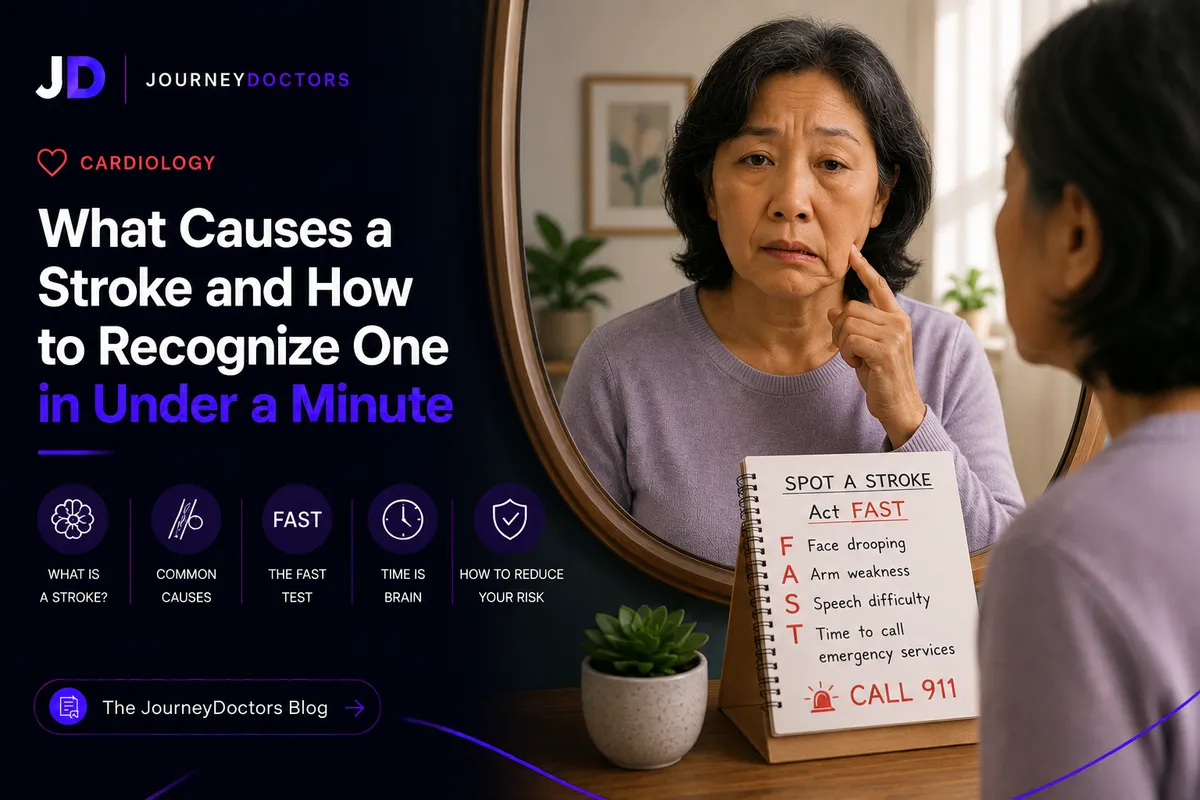
Stroke is a medical emergency in which blood supply to part of the brain is suddenly cut off, causing brain cells to die within minutes. It is the second leading cause of death globally and the leading cause of acquired disability in adults. The reason early recognition is so critical is not abstract: with ischemic stroke, the most common type, effective treatment can dissolve the clot or remove it mechanically, restoring blood flow and preventing or limiting brain damage. But this treatment is only available within a specific time window, and that window closes fast. Every minute that passes after a stroke begins, approximately 1.9 million neurons die. Recognizing a stroke and calling for emergency help without delay is one of the most life-saving things a bystander or patient can do.
What Happens in a Stroke
The brain is the most metabolically demanding organ in the body, consuming approximately 20 percent of the body's total oxygen supply despite representing only 2 percent of its mass. It has essentially no energy reserves and relies on continuous blood flow. When that flow is interrupted, neurons begin to die within minutes. The area of brain affected by loss of blood supply, and the functions it serves, determine the symptoms that result.
Ischemic stroke, accounting for approximately 87 percent of strokes, occurs when a blood clot blocks an artery supplying the brain. The clot may form locally in an artery narrowed by atherosclerosis (thrombotic stroke) or travel from elsewhere, most commonly the heart or a carotid artery, to lodge in a cerebral vessel (embolic stroke). Hemorrhagic stroke, accounting for the remaining 13 percent, occurs when a blood vessel in or around the brain ruptures, causing bleeding that destroys tissue directly and raises intracranial pressure. Hemorrhagic stroke has a higher short-term mortality than ischemic stroke and requires different treatment.
Recognizing a Stroke: FAST and Beyond
The FAST acronym captures the most visible and common stroke symptoms. Face drooping: ask the person to smile. If one side of the face droops or the smile is uneven, this is a stroke warning sign. Arm weakness: ask the person to raise both arms. If one arm drifts downward or cannot be raised, this indicates weakness on one side of the body. Speech difficulty: ask the person to repeat a simple phrase. If speech is slurred, garbled, or the person cannot speak or understand speech, this is a warning sign. Time to call emergency services: if any of these signs are present, call for emergency help immediately without waiting to see if symptoms improve.
An expanded version, BEFAST, adds two preceding warning signs. Balance: sudden loss of balance or coordination. Eyes: sudden vision change in one or both eyes, including double vision, vision loss, or visual field defect. These precede the original FAST criteria and capture stroke presentations that begin with these less recognized features.
Symptoms That Are Stroke Until Proven Otherwise
JourneyDoctors
Not sure if this applies to you?
Describe your symptoms to Dr. Maya — our AI GP — and get a real clinical response in under a minute. Free to start.
Talk to Dr. MayaThe following symptoms, particularly when of sudden onset, should be treated as stroke until proven otherwise. Sudden severe headache with no known cause, often described as the worst headache of their life, can signal subarachnoid hemorrhage. Sudden numbness or weakness of the face, arm, or leg, especially on one side of the body. Sudden confusion, difficulty understanding or speaking. Sudden visual disturbance. Sudden difficulty walking, loss of coordination, or dizziness.
The critical word is sudden. Stroke symptoms come on abruptly. A headache that has been building over a week, or weakness that has been getting slowly worse over months, is unlikely to be stroke. The time of symptom onset is information that emergency and clinical teams will need; if you witness a stroke, note or write down the time the symptoms began.
Transient Ischemic Attack: Do Not Ignore It
A transient ischemic attack (TIA) produces stroke-like symptoms that resolve completely within 24 hours, usually within minutes. It is caused by a temporary interruption of blood flow without permanent brain injury. It is emphatically not a benign event. A TIA is a warning that the mechanism causing stroke is present and active. The risk of a full stroke in the days following a TIA is significant: approximately 10 to 15 percent within three months, with the highest risk in the first 48 hours. Every TIA should be evaluated urgently, ideally within 24 hours, to identify and treat the underlying cause and initiate stroke prevention measures before a major stroke occurs.
Causes and Risk Factors
Atrial Fibrillation
Atrial fibrillation is one of the most important causes of cardioembolic stroke. The chaotic atrial activity in AFib allows blood to pool and clot in the left atrial appendage; these clots can break off and travel to cerebral vessels. AFib increases stroke risk five to sevenfold compared to the general population. Anticoagulation therapy, which prevents clot formation in the atrium, dramatically reduces this risk and is one of the most impactful preventive interventions in stroke prevention. Many people are unaware they have AFib until a stroke occurs, which is one reason routine pulse assessment and heart rhythm monitoring in older adults is clinically important.
Hypertension
High blood pressure is the single most important modifiable risk factor for stroke, responsible for approximately half of all strokes globally. It damages artery walls directly, accelerates atherosclerosis, weakens small perforating arteries making them susceptible to rupture, and promotes atrial fibrillation. Controlling blood pressure is the highest-yield single intervention for stroke prevention across all populations.
Carotid Artery Disease
Atherosclerotic plaque in the carotid arteries (the main arteries supplying the brain in the neck) is a significant source of thrombotic and embolic stroke. A high-grade carotid stenosis, detectable by ultrasound, may be amenable to surgical endarterectomy or stenting in appropriate patients. Carotid bruits detected on physical examination prompt investigation, though many significant stenoses are silent.
Diabetes
Diabetes approximately doubles stroke risk through accelerated atherosclerosis, endothelial dysfunction, and coagulopathy. Good glycemic control, particularly in type 2 diabetes, reduces stroke risk, as does management of the associated cardiovascular risk factors including hypertension and dyslipidemia.
Smoking
Smoking approximately doubles stroke risk through effects on blood vessel walls, platelet aggregation, and blood pressure. Smoking cessation rapidly reduces stroke risk, with substantial risk reduction within two years of stopping.
Lipid Abnormalities
Elevated LDL cholesterol drives atherosclerosis in the carotid and cerebral arteries. Statins, beyond their lipid-lowering effects, have direct plaque-stabilizing properties that reduce stroke risk in people with established cardiovascular disease or high risk.
Acute Treatment: Why Every Minute Matters
For ischemic stroke, intravenous thrombolysis (alteplase) can dissolve the clot if given within 4.5 hours of symptom onset. Mechanical thrombectomy, which physically removes the clot through a catheter, can be performed up to 24 hours in selected patients with large vessel occlusion and salvageable brain tissue on imaging. Both treatments are highly effective when used within their time windows. The functional outcomes after successful treatment, particularly thrombectomy, can be dramatic: patients who would otherwise face permanent disability make near-complete recoveries when treatment is delivered promptly.
This is why calling emergency services immediately is so critical. It is not possible to determine from symptoms alone whether a stroke will be treatable. The right response to any stroke presentation is emergency evaluation, not watching to see if it gets better.
Stroke Rehabilitation
After the acute phase, rehabilitation is the primary driver of recovery. The brain has significant capacity for neuroplasticity, the ability to reorganize and form new connections. Physiotherapy, occupational therapy, and speech therapy in the weeks and months after stroke drive meaningful recovery of function. The intensity and early initiation of rehabilitation strongly predicts outcome. Depression after stroke is extremely common, affecting approximately a third of survivors, and should be screened for and treated, as it significantly impairs engagement with rehabilitation.
When to Seek Emergency Help
If you observe any stroke symptoms in yourself or another person, call emergency services immediately. Do not give aspirin unless directed by emergency services in your jurisdiction (aspirin is appropriate for ischemic stroke but harmful in hemorrhagic stroke, which cannot be distinguished without imaging). Do not give the person food or drink. Note the time symptoms began. Stay with the person until help arrives.
Disclaimer: This article is for educational purposes only and does not constitute medical advice. If you think you or someone else may be having a stroke, call emergency services immediately. Do not use a telemedicine service in an acute stroke emergency.
Get proper care
Ready to speak with a specialist?
If anything in this article sounds familiar, the right next step is a proper evaluation. JourneyDoctors connects you with a specialist in minutes. Consultations from $19.
See a specialist nowFrequently Asked Questions
What is the difference between a stroke and a TIA?
A stroke causes permanent brain injury due to sustained interruption of blood flow. A TIA causes temporary symptoms that resolve completely because blood flow is restored before permanent injury occurs. Both are caused by the same mechanisms and require urgent evaluation. A TIA is not a safe event; it is a warning that significantly elevated stroke risk is present in the immediately following days and weeks.
Can young people have strokes?
Yes. While stroke risk increases substantially with age, strokes occur in young adults and even children. In younger adults, less common causes including patent foramen ovale (a hole in the heart present since birth), hypercoagulable disorders, illicit drug use (particularly cocaine and amphetamines), cervical artery dissection, and certain autoimmune conditions account for a higher proportion of cases than in older adults. Stroke in a young person always warrants thorough investigation for underlying causes.
How long does stroke recovery take?
Recovery varies enormously based on the size and location of the stroke, the effectiveness of acute treatment, and the intensity of rehabilitation. The greatest recovery typically occurs in the first three to six months, when neuroplasticity is most active, though measurable improvement can continue for years. Some patients make near-complete recovery; others have permanent deficits. The trajectory of recovery cannot be predicted precisely in the acute period.
Does aspirin prevent stroke?
Aspirin reduces platelet aggregation and is used for secondary stroke prevention in patients who have had an ischemic stroke or TIA. It is not recommended for primary stroke prevention in the general population without established cardiovascular disease or high risk, because the bleeding risk offsets the benefit in lower-risk individuals. The decision to use aspirin preventively should be made with a physician based on individual risk assessment.
Can lifestyle change prevent stroke?
Yes, substantially. Blood pressure control is the highest-yield single intervention. Not smoking, managing atrial fibrillation with anticoagulation, controlling cholesterol, treating diabetes, maintaining a healthy weight, engaging in regular physical activity, limiting alcohol, and eating a Mediterranean-pattern diet collectively reduce stroke risk by approximately 80 percent. The majority of strokes are preventable with appropriate risk factor management.
Written by
Dr. Adaeze Nwosu
Cardiology