

Type 2 Diabetes Management Beyond Metformin
Metformin remains first-line, but the newer diabetes medications have changed what is possible. GLP-1 agonists and SGLT2 inhibitors do not just lower blood sugar — they protect the heart and kidneys in ways older drugs do not.
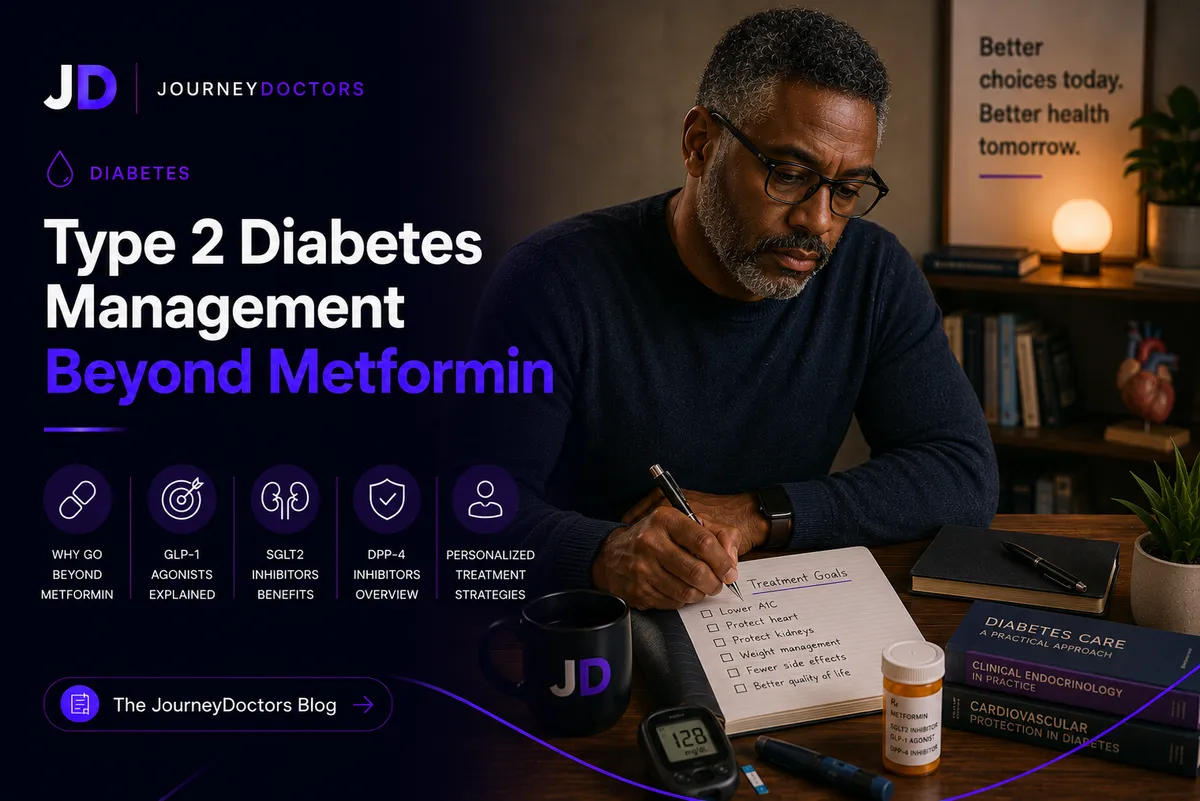
For most of the last half century, type 2 diabetes management followed a predictable script: start with metformin, add a sulfonylurea if needed, escalate to insulin when oral medications were no longer sufficient. That framework still exists, but the medications available to work within it have changed dramatically in the last decade. GLP-1 receptor agonists and SGLT2 inhibitors are not just blood sugar drugs. They have cardiovascular and renal protective effects that have reshaped the treatment hierarchy, and understanding them matters whether you are newly diagnosed or have been managing diabetes for years.
Why Metformin Is Still First
Metformin remains the first-line medication for type 2 diabetes in most guidelines and for good reason. It has decades of safety data, a well-understood mechanism, meaningful HbA1c reduction (typically 1 to 1.5%), no risk of hypoglycemia, modest weight neutrality, and a cost that is close to zero on most formularies. It works primarily by reducing hepatic glucose production and improving insulin sensitivity in peripheral tissues.
The main limitations are gastrointestinal side effects, which affect roughly 20 to 30% of patients and can be mitigated by taking it with food or using extended-release formulations, and contraindication in significant kidney disease, where the risk of lactic acidosis becomes relevant at eGFR below 30.
When metformin alone is insufficient to reach glycemic targets, or when a patient has cardiovascular or renal comorbidities that warrant additional protection, the choice of second agent has become significantly more nuanced.
GLP-1 Receptor Agonists
Glucagon-like peptide-1 (GLP-1) receptor agonists mimic the action of GLP-1, an incretin hormone released from the gut after eating. They stimulate insulin secretion in a glucose-dependent manner (meaning they do not cause hypoglycemia when glucose is normal), suppress glucagon, slow gastric emptying, and act on the brain to reduce appetite and food intake.
The agents in this class include semaglutide (Ozempic, Wegovy), liraglutide (Victoza), dulaglutide (Trulicity), and exenatide, among others. They are administered by subcutaneous injection, though oral semaglutide is now available. HbA1c reductions of 1 to 2% are typical. Weight loss of 5 to 15% of body weight is common and is a clinically meaningful benefit independent of glucose control.
The cardiovascular data for GLP-1 agonists is strong. The LEADER trial with liraglutide and the SUSTAIN-6 trial with semaglutide both demonstrated significant reductions in major adverse cardiovascular events (MACE) in patients with established cardiovascular disease. Current guidelines recommend GLP-1 agonists as a preferred second agent in patients with type 2 diabetes and established atherosclerotic cardiovascular disease.
Common side effects are nausea and vomiting, which are most pronounced at initiation and with dose escalation and typically improve over weeks. Rare but serious concerns include pancreatitis and, based on rodent data, theoretical thyroid C-cell effects, which are a contraindication in patients with personal or family history of medullary thyroid carcinoma.
SGLT2 Inhibitors
JourneyDoctors
Not sure if this applies to you?
Describe your symptoms to Dr. Maya — our AI GP — and get a real clinical response in under a minute. Free to start.
Talk to Dr. MayaSodium-glucose cotransporter-2 (SGLT2) inhibitors work in the kidney. They block the reabsorption of glucose in the proximal tubule, causing excess glucose to be excreted in the urine. This lowers blood glucose independently of insulin. The agents include empagliflozin (Jardiance), dapagliflozin (Farxiga), and canagliflozin (Invokana).
HbA1c reductions are typically 0.5 to 1%, which is modest compared to GLP-1 agonists. But the story of SGLT2 inhibitors is not primarily about glucose. The cardiovascular and renal outcome data is among the most striking in modern diabetes pharmacology.
The EMPA-REG OUTCOME trial showed that empagliflozin reduced cardiovascular death by 38% in patients with type 2 diabetes and established cardiovascular disease. The DAPA-HF and EMPEROR-Reduced trials demonstrated that SGLT2 inhibitors reduce hospitalisation for heart failure and cardiovascular death in patients with heart failure, with effects that appear independent of diabetes status. SGLT2 inhibitors are now indicated for heart failure with reduced ejection fraction regardless of diabetes.
The renal protection data is similarly compelling. The CREDENCE and DAPA-CKD trials showed that SGLT2 inhibitors significantly slow progression of diabetic kidney disease, with effects on proteinuria and eGFR decline that translate to meaningful preservation of kidney function over years.
Current guidelines now recommend SGLT2 inhibitors as the preferred second agent (alongside or instead of GLP-1 agonists) in patients with type 2 diabetes and heart failure or chronic kidney disease.
Side effects include genital mycotic infections (thrush), which affect roughly 10% of women and 4% of men and typically respond to standard antifungal treatment. Euglycaemic diabetic ketoacidosis is a rare but serious complication requiring prompt recognition. SGLT2 inhibitors should be held before surgery and during illness with reduced oral intake.
DPP-4 Inhibitors
Dipeptidyl peptidase-4 (DPP-4) inhibitors, including sitagliptin (Januvia), saxagliptin, and linagliptin, work by preventing the breakdown of endogenous GLP-1, amplifying its effects. They are weight neutral, have a low side effect profile, and carry no hypoglycaemia risk. HbA1c reductions are modest at 0.5 to 0.8%.
Their role has diminished somewhat since GLP-1 agonists became more accessible, because GLP-1 agonists offer similar glucose-lowering with additional cardiovascular benefit and weight loss. DPP-4 inhibitors remain a reasonable option for patients who need modest additional glucose lowering without weight gain, who cannot tolerate injections, or for whom cost is a significant factor.
Sulfonylureas and Insulin
Sulfonylureas (glipizide, glimepiride, glyburide) stimulate insulin secretion independently of glucose. They are effective at lowering HbA1c (1 to 1.5%) and are inexpensive but cause weight gain (2 to 5 kg) and carry meaningful hypoglycaemia risk. They do not have cardiovascular or renal protective effects. Their role in modern diabetes management is primarily as a cost-effective option when newer agents are unaffordable.
Insulin remains necessary for patients whose pancreatic function has declined to the point where endogenous production is insufficient. Starting insulin is not a failure. It is a physiological replacement for a function that has been lost, and modern insulin regimens with basal-bolus dosing or insulin degludec offer substantial improvement in hypoglycaemia risk over older formulations.
Choosing the Right Approach
The current framework recommended by the American Diabetes Association and most international guidelines prioritises cardiovascular and renal risk as the primary driver of second-line drug choice. If a patient has established cardiovascular disease, a GLP-1 agonist with proven cardiovascular benefit is preferred. If they have heart failure or significant kidney disease, an SGLT2 inhibitor is prioritised. If weight loss is a primary concern alongside glucose control, GLP-1 agonists are preferred. If cost is limiting, sulfonylureas and older agents remain appropriate.
These decisions require knowing a patient's full picture: their HbA1c trajectory, their cardiovascular and renal status, their weight, their tolerance for injections, and what their insurance will cover. They are not one-size decisions.
When to See a Doctor
If your HbA1c is not at target on your current regimen, if you have cardiovascular disease or kidney disease and are not on a GLP-1 agonist or SGLT2 inhibitor, or if you have questions about newer medications you have heard about, speak with a clinician. A JourneyDoctors physician can review your current regimen, assess whether medication adjustment is appropriate, and coordinate with your primary care team on next steps.
Disclaimer: This article is for educational purposes only and does not constitute medical advice. Always consult a qualified healthcare professional for diagnosis and treatment.
Get proper care
Ready to speak with a specialist?
If anything in this article sounds familiar, the right next step is a proper evaluation. JourneyDoctors connects you with a specialist in minutes. Consultations from $19.
See a specialist nowFrequently Asked Questions
Is Ozempic the same as a diabetes drug?
Yes. Semaglutide (brand name Ozempic for diabetes, Wegovy for weight loss) is a GLP-1 receptor agonist originally approved for type 2 diabetes. Wegovy is a higher-dose formulation approved specifically for weight management in people with obesity, including those without diabetes. The active ingredient is the same.
Can I stop metformin if I start a newer medication?
Usually not automatically. Metformin is typically continued alongside newer agents unless there is a specific contraindication such as significant kidney disease. The combination of metformin with a GLP-1 agonist or SGLT2 inhibitor produces greater HbA1c reduction than either alone. Your clinician will advise on your specific situation.
Do GLP-1 agonists work for weight loss without diabetes?
Yes. Semaglutide and liraglutide are approved for weight management in people without diabetes at higher doses. The weight loss mechanism is the same: appetite suppression and slowing of gastric emptying. The cardiovascular outcome data in people without diabetes is still accumulating.
How do I know if my diabetes medications are working?
HbA1c checked every three months when adjusting therapy, and every six months when stable, is the primary monitoring tool. Fasting glucose provides shorter-term feedback. Your clinician will also monitor kidney function, liver function, and cardiovascular risk factors at regular intervals depending on your medications.
Are SGLT2 inhibitors safe for kidneys?
Yes, and they actively protect the kidneys in patients with diabetic kidney disease. They are contraindicated when eGFR falls below a threshold (currently below 20 for most indications), because their glucose-lowering mechanism requires sufficient kidney function to work. But in patients with mild to moderate kidney disease, they slow progression and are recommended specifically for that reason.
Written by
Dr. James Okafor
Internal Medicine